Conference Call for Papers: Academic Entrepreneurship, and Knowledge and Technology Transfer

Academic Entrepreneurship, and Knowledge and Technology Transfer: How do they relate to Research, Teaching, and Universities as Organizations?

April 11-12, 2016, University of Kassel, Germany

Confirmed Keynote Speakers: Aldo Geuna (Torino), Walter W. Powell (Stanford)

Organized by: Guido Bünstorf, Georg Krücken, and Christian Schneijderberg

(International Centre for Higher Education Research, University of Kassel)

Spin-off entrepreneurship, patenting, licensing and other activities of knowledge and technology transfer from universities to the private sector have attracted considerable scholarly attention. A large number of studies from a broad range of disciplinary and interdisciplinary backgrounds have investigated these activities. These prior efforts notwithstanding, important questions about academic entrepreneurship, commercialization and knowledge and technology transfer are still unanswered. This conference aims to help develop answers to these questions. In particular, contributions are invited that study how academic entrepreneurship, commercialization and transfer relate to research, teaching (including entrepreneurship education), as well as the nature and development of the university as an organization.

Continue reading “Conference Call for Papers: Academic Entrepreneurship, and Knowledge and Technology Transfer”

Call for Papers on the Changing Nature of Work

To kindle interest in discovering contemporary worlds of work and occupations and in the hope of building more accurate and nuanced images of jobs, organizations, economies and people’s lives, the Academy of Management Discoveries announces a special issue devoted to the changing nature of work.

No one disputes that the structure of Western economies has shifted away from one based primarily on manufacturing to one increasingly dominated by services and the professions, broadly construed. Many also claim that the nature and structure of organizations, jobs, and careers have also changed substantially (e.g., Evans, Kunda, & Barley, 1994; Hall, 1996; Rousseau, 1997). As the author of a recent article in New York magazine noted: “The traditional compact between employers and employees is slowly fading away, and with it, a way of thinking, a way of living, a way of relating to others and regarding oneself that generally comes with a reasonably predictable professional life” (Senior, 2015:1). Yet, with a few exceptions. organizational scholars have paid surprisingly little attention to studying how work, occupations, and careers are changing (Barley and Kunda, 2001).

Continue reading “Call for Papers on the Changing Nature of Work”

Call for Papers: Turkish Journal of Sociology

The Turkish Journal of Sociology wishes to publish its first issue devoted to military sociology. First published in 1917, The Turkish Journal of Sociology is a publication of the Department of Sociology of the Istanbul University Faculty of Letters, the first and leading sociology department in Turkey. The Turkish Journal of Sociology is a peer-reviewed, biannually published journal (http://journals.istanbul.edu.tr/iusosyoloji).

Modern militaries have undergone considerable change in recent decades. This is a reflection of dramatic changes in society, including changes in inter- and intra-state politics, public opinion, civil-military relations, demographics, and both short-and long-term military engagements around the world. Within Turkey, issues surrounding the military have received considerable attention in the political science, military history, and military science arenas. However, amid the quickly changing contexts in which its military operates, in tandem with its importance domestically and internationally, Turkey remains an understudied country in the field of military sociology studies.

Continue reading “Call for Papers: Turkish Journal of Sociology”

My Time with Talcott

Between 1970 and 1973, Anant Negandhi held a series of conferences at Kent State University, sponsored by the Comparative Administration Research Institute. Kent State was then a leading business school in the fields of international business, management, and marketing. Negandhi thought that this emerging field would benefit from the contributions of young scholars in various social science fields, such as sociology. The conference focus was on “the various conceptual problems encountered in studying the functioning of complex social organizations.” Negandhi started a journal that published the papers presented at his conferences, but it lasted only 5 issues.

I took part in several of these, including one that led to the publication of a book on Interorganizational Theory, edited by Negandhi. These conferences attracted a stellar cast of organization scholars, including Richard Hall, Don Hellriegel, David Hickson, Hans Penning, Jeff Pfeffer, Lou Pondy, Jon Slocum, Andy Van de Ven, and Donald Warren. Looking back, I’m astonished that he was able to attract this group to a regional state university in the Northeastern corner of Ohio. Up to that point, Kent State was known primarily for the infamous killings of four students by the Ohio National Guard during a peaceful protest against the Cambodian invasion. Indeed, memories of that tragedy were still in my mind when I contemplated whether to accept Negandhi’s invitation to attend the conferences.

In addition to people known for their contributions to organizational studies, Negandhi invited Talcott Parsons to the conference because of Parsons’ interest in institutional theory and organizations. In 1956, Parsons published two lead-off articles in two successive issues of the Administrative Science Quarterly, laying out what he called “suggestions for a sociological approach to the theory of organizations.” In our book, Organizations Evolving, Martin Ruef and I gave Parsons a great deal of credit for offering one of the first systematic presentations of a multilevel theory of organizations’ relations with their environments. He anticipated many of the themes that institutional theorists of organizations “rediscovered” many years later and his essays are still worth reading today.

Parsons had just announced his retirement in the spring of 1973, after 42 years at Harvard.

Fortunately for me, Anant held a small dinner party for Parsons at his house and some of the other speakers at the conference. I wish I could report that Parsons and I enjoyed a spirited exchange about the application of evolutionary theory to organizational studies, but I’m afraid I was so awestruck just being in his presence that I mostly stuck to asking the banal questions that junior professors tend to put to famous scholars.

Jean Boddewyn, from NYU, took pictures at the party and sent several to me, including the one shown below. The photo shows Parsons, cigarette in hand, holding court, while I sit to his left in rapt attention. Thankfully, the photo is not in color, or else you would see that the houndstooth pattern on my jacket is a mix of fire-engine red checks on a white background. We took lots of fashion risks in the early 1970s!
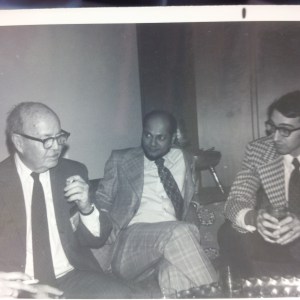
Talcott Parsons Kent State Spring 1973

Parsons’ chain-smoking is probably what I remember best about that evening. Memories of his habit are confirmed in an interview Parsons did with Robert Reinhold for the ASA Newsletter around the time of his retirement, when he was asked about his role in American sociology and the bridge he provided to European sociologist. In reply to a question, he said “it happened to be my particular role, as it were, to act as an importer,” and Reinhold then noted that Parsons said this as he lit up the first of six cigarettes consumed down to the filter in the course of a one hour interview.  ASA Footnotes, August 1973.

Parsons died in 1979, aged 77.


Conference Announcement: “Connecting Students to the Labor Movement”

“Connecting Students to the Labor Movement”
Annual Meetings of the Southern Labor Studies Association
March 6–8, 2015
Washington, DC – The George Washington University

Deadline: February 9, 2015
(Papers not necessary)

We invite labor activists and academics alike to participate in a panel to discuss how they have used the classroom as a conduit to engage students in the labor movement. This session, open to activists and academics, will offer lessons for new or emerging collaborative projects and can serve as a bridge between activists/scholars working independently but with similar goals. Participants may wish to address such questions as: What do unions need from student volunteers? What can students, faculty, and universities gain from working with unions? What can students contribute to fights for economic justice, both when workers on campus are seeking student support and when students contribute to campaigns removed from their campus? What obstacles do academic-activist collaborations present and how can they be overcome?

If you have questions or are interested in joining us in Washington, DC this March, contact Jeff Larson (jlarson@towson.edu) or Kate O’Neil (k8oneil@gmail.com).

The Medici Summer School in Management Studies

We are pleased to announce the organization of the 7th edition of the Medici Summer School in Management Studies for doctoral students and young researchers which will be held in Bologna, May 31st – June 5th, 2015. The school is organized and sponsored by BBS (University of Bologna Business School), HEC Paris (Society and Organizations Research Center and the HEC Foundation), and MIT Sloan School of Management (Economic Sociology PhD Program). This year’s theme is “Social Valuation in Organizational, Interpersonal, and Market Contexts.”

The Summer School is designed to promote doctoral education and research organization theory and related fields (economic sociology, management studies, strategy) and contribute to the development of enlightened practice in the management of business organizations. The Medici Summer School advocates a special focus on cross-fertilizing research across North American and European traditions. The Summer School is a unique educational program for qualified doctoral students interacting with thought leaders in the management field who have shared their knowledge and wisdom on frontier research topics.

For more information, please visit http://www.medicisummerschool.it/

Call for submissions – Work in Progress blog

The Work in Progress blog, of the Organizations, Occupations and Work section of the ASA, invites submissions (800-1,200 words) on all topics related to organizations, occupations and work, broadly understood. The primary purpose of the blog is to disseminate sociological findings and ideas to the general public. Articles should be accessible and jargon-free, written like a New York Times op-ed. We currently get over 3,000 views per month and are followed on social media by journalists from the New York Times, Washington Post, NPR, BBC and other outlets.

We will publish summaries by authors of all monographs related to organizations, occupations and work. Additionally, we invite proposals for three types of article: research findings (from your own study or summarizing the findings of others), news analysis, commentary. Interested authors should send a proposed title and topic (one paragraph maximum) to Matt Vidal (matt.vidal@kcl.ac.uk). The WIP Editorial Team will decide whether to invite a full submission.

New book: Research in Organizational Behavior, Volume 34

Hooray! Another volume of Research in Organizational Behavior is available. Examples of distinguished scholars included in the volume include Nalini Ambady, Michel Anteby, Karl Aquino, Julie Battilana, Max Bazerman, Taya Cohen, Francesca Gino, Denny Gioia, Henrich Greve, Aron Kay, Mike Morris, Huggy Rao, and Phil Tetlock.

Enjoy,

Art Brief & Barry Staw

Research in Organizational Behavior
Volume 34, Pages 1-236 (2014)

List of Contributors<http://www.sciencedirect.com/science/article/pii/S0191308514000173>
Page ii
Continue reading “New book: Research in Organizational Behavior, Volume 34”

ILRR call for papers: Reducing Inequality in Organizations

ILR Review

Call for Papers

Special Issue and Conference on Reducing Inequality in Organizations:

What Works? What Doesn’t?

The ILR Review is calling for papers for a conference and a subsequent special issue devoted to identifying and developing organizational practices and processes that affect workplace inequality, diversity, and inclusion. We seek innovative research that will advance our understanding of the organizational arrangements that help to reduce the effects of bias and to promote diverse and inclusive workplaces. Emilio J. Castilla (MIT) and Pamela S. Tolbert (ILR, Cornell) will be the guest editors of the issue.

Continue reading “ILRR call for papers: Reducing Inequality in Organizations”