Member Publication: Unmasking work-family balance barriers and strategies among working fathers in the workplace

Please check out the recent publication by OOW members Sabrina Tanquerel and Marc Grau-Grau.

Tanquerel, Sabrina, and Marc Grau-Grau. 2020. “Unmasking Work-Family Balance Barriers and Strategies among Working Fathers in the Workplace.” Organization 27 (5): 680–700.

Abstract:

This article explores the barriers and strategies experienced by Spanish working fathers regarding work-family balance. Based on 29 in-depth interviews with Spanish working fathers in different types of organizations and sectors, the results of this study present different barriers that are divided into three groups: contextual barriers, organizational barriers and internalized barriers. The results also suggest that the study’s participants fall into three categories or patterns: hegemonic gender order conformers, borderers and deviants, who use three different strategies (no strategies, invisible strategies and visible strategies) to overcome the barriers detected in this research. The dynamics of reinforcing, being complicit and challenging hegemonic masculinities within the workplace are discussed in light of recent theories regarding gender and organizations, masculinities and fatherhood.

Call for Papers: Issue of RSF: The Russell Sage Foundation Journal of the Social Sciences

Issue of RSF: The Russell Sage Foundation Journal of the Social Sciences on:

Administrative Burdens as a Mechanism of Inequality in Policy Implementation

Edited by
Pamela Herd, Georgetown University
Hilary Hoynes, University of California Berkeley
Jamila Michener, Cornell University
Donald Moynihan, Georgetown University

This special issue invites empirical papers that seek to enlarge our understanding of how administrative burdens contribute to inequality in policy implementation processes and outcomes, and potential solutions to these problems. Administrative burdens are people’s experiences of policy implementation as onerous. Burdens include learning costs, i.e., the time and effort it takes to find information about public services and what is required to access them; compliance costs, which include the paperwork needed to demonstrate eligibility, and the time and financial costs required by administrative processes. Administrative burdens also take the form of psychological costs. Psychological costs include the experience of stigma from applying for and participating in an unpopular program. They might also arise via a sense of a loss of autonomy when people feel they are subject to intrusive or coercive state power, the stresses from not knowing whether one can negotiate administrative ordeals where critical resources hang in the balance, or the accumulation of frustrations that come with burdens, especially those seen as unjust or unnecessary.

Social scientists have grappled with this issue from specific disciplinary perspectives. Economics has focused on ‘take-up’ or how these barriers impede access, for eligible populations, to social welfare policies. Political science has explored how politics can shape the creation of burdens and how the experience of burdens can influence beliefs such as political efficacy and trust in government. Sociology has emphasized how these burdens, within the context of organizations, are both a function of and a contributor to gender, race, and class inequality. Public administration has clarified the organizational basis of administrative burdens, including the use of bureaucratic discretion. The goal of this issue is to bring insights from multiple disciplines to grapple with the broader implications of these burdens for inequality.

Please click here for a full description of the topics covered in this call for articles.

Anticipated Timeline

Prospective contributors should submit a CV and an abstract (up to two pages in length, single or double spaced) of their study along with up to two pages of supporting material (e.g., tables, figures, pictures, references that don’t fit on the proposal pages, etc.) no later than 5 PM EST on April 21, 2021 to:

https://rsf.fluxx.io

NOTE that if you wish to submit an abstract and do not yet have an account with us, it can take up to 48 hours to get credentials, so please start your application at least two days before the deadline. All submissions must be original work that has not been previously published in part or in full. Only abstracts submitted to https://rsf.fluxx.io

will be considered. Each paper will receive a $1,000 honorarium when the issue is published. All questions regarding this issue should be directed to Suzanne Nichols, Director of Publications, at journal@rsage.org and not to the email addresses of the editors of the issue.

A conference will take place at the Russell Sage Foundation in New York City on February 25, 2022. The selected contributors will gather for a one-day workshop to present draft papers (due a month prior to the conference on 1/25/22) and receive feedback from the other contributors and editors. Travel costs, food, and lodging for one author per paper will be covered by the foundation. Papers will be circulated before the conference. After the conference, the authors will submit their revised drafts by 6/1/22. The papers will then be sent out to three additional scholars for formal peer review. Having received feedback from reviewers and the RSF board, authors will revise their papers by 11/1/22. The full and final issue will be published in the fall of 2023. Papers will be published open access on the RSF website as well as in several digital repositories, including JSTOR and UPCC/Muse.

Please click here for a full description of the topics covered in this call for articles.

Job Posting: Postdoc at the VMware Women’s Leadership Innovation Lab at Stanford University

Stanford Impact Labs is a new initiative at Stanford University investing in highly-motivated teams of researchers and practitioners—impact labs—to generate new insights and solutions to persistent social problems. To begin in the Fall of 2021, Stanford Impact Labs is now accepting applications to the two-year postdoctoral fellowship program in collaboration with three impact labs.

As part of this inaugural program, the VMware Women’s Leadership Innovation Lab is seeking a diverse pool of applicants who wish to join a team-based, collaborative community that value the different skills, expertise, and perspectives necessary to design, conduct, sustain, and disseminate public impact research. 

The VMware Women’s Leadership Innovation Lab at Stanford University generates foundational research to advance women’s leadership by diagnosing barriers, developing and evaluating interventions to get beyond barriers, and disseminating research-based solutions by bridging the gap between research and practice. 

Based on their expertise, the postdoctoral fellow will engage with the lab community on a variety of projects such as: implementing and evaluating interventions to increase women’s representation, persistence, and inclusion in male and white dominated learning and work environments; understanding the specific barriers faced by women of different racial and ethnic backgrounds in the workplace; creating and disseminating new approaches to create and engage change agents to accelerate gender equality. 

Mentorship Structure

The postdoctoral fellow will be supervised by Prof. Shelley Correll and will collaborate with research scholars, staff, and PhD students affiliated with the lab. Mentorship of the Postdoctoral Associate will be structured according to research and professional interests. 

In addition, a goal of the Stanford Impact Labs Postdoctoral Fellowship Program is to create a diverse community of scholars who are committed to producing research that has a positive impact on society. Postdoctoral fellows will have the opportunity to engage with one other and with the broader Stanford Impact Labs team and community, and will be invited to participate in select activities (approx. 10% total effort), as guided by each fellow’s particular interests and in coordination with the SIL team and respective lab.

Qualifications

  • Has or expects to have a PhD by September 1st, 2021
  • Has research expertise at the intersection of gender and race in organizations (broadly defined, from K-12 to the workplace). Sub-areas of interest include:
    • Bias and stereotypes at the intersection of gender and race
    • Racialized and gendered organizational processes
    • Social psychological interventions to create equitable organizations 
  • Demonstrates excellent written and verbal communication skills.
  • Is committed to advancing solutions to social problems through rigorous research, and communicating research findings to diverse audiences, including non-academic audiences.
  • Wishes to grow their collaborative research skills and ability to partner with organizations.  

Timeline

  • Review of applications will begin on March 1, 2021.
  • Those advancing will be notified by March 15, and may be asked to submit additional materials (e.g. 2-3 writing samples and 2 letters of recommendation), and/or invited to interview.
  • Final selections will be made by early April.

To apply: To be ensured of full consideration, please upload the following materials in a single PDF document to https://bit.ly/3cmpdS4 before March 1:

  • CV: Provide a curriculum vitae of no more than 5 pages 
  • Letter of interest explaining your motivation to become a postdoc with the VMWare Women’s Leadership Innovation Lab through the Stanford Impact Labs fellowship program (500 words max)
  • Short responses to the following three prompts, in 300 words or less for each:
    • Please provide a short description of your dissertation research and broader research agenda.
    • How does your research training and expertise prepare you to make progress towards understanding and identifying practical solutions to social problems? 
    • In what ways have you contributed towards and/or demonstrated a commitment to inclusion, equity, and diversity through your academic career, and how do you plan to advance these commitments professionally?

Stanford is an equal opportunity employer and all qualified applicants will receive consideration without regard to race, color, religion, sex, sexual orientation, gender identity, national origin, disability, veteran status, or any other characteristic protected by law.

Call for Applications: The Warwick Summer School on Practice and Process Studies

2021 Warwick Summer School on Practice and Process Studies:
Pushing the Boundaries of Sociomateriality

Including Beginners’ Introduction to Practice and Process Theory

University of Warwick, 27th – 29th July 2021
Co-directors: Katharina Dittrich, Mira Slavova and Matt Hurst

The 9th Warwick Summer School aims to convene scholars interested in practice and process studies in an open and multi-disciplinary learning community characterized by dialogue, discussion, and joint exploration. The Summer School is designed for scholars with an advanced understanding of practice and process theories. The three days will consider the state-of-the-art of practice, process and routines studies (2 days) and how practice and process studies can push the boundaries of understandings of sociomateriality (1 day). The event will take place online. If government restrictions allow a one-day physical meeting may take place for local participants (To be confirmed by mid-April). ​

Beginners’ Introduction to Practice and Process Theory, Online (BST), 21st July 2021

A one-day introductory session is available to all scholars new to the field and interested in better understanding the potential of practice and process theory for their research. No prior experience is required. ​

State-of-the-art Understandings

During the first two days the program of the 2021 Warwick Summer School will cover the latest advancements in thinking about and the doing of practice and process studies. Attendees will have the opportunity to share manuscripts, research proposals, and progress reports during ‘research clinics’ and receive feedback on their work from seasoned faculty including:​

Davide Nicolini, Warwick Business School​
Katharina Dittrich, Warwick Business School​
Mira Slavova, Warwick Business School​
Jorgen Sandberg, University of Queensland & Warwick Business School​
Hari Tsoukas, University of Cyprus & Warwick Business School 

2021 Theme: Pushing the Boundaries of Sociomateriality

Each summer school we explore a field and where it could head in the future. This year our keynote speaker Wanda Orlikowski (MIT Sloan School of Management) will share her views on the current state of the field of sociomateriality and what new directions might be possible in future cutting-edge research. For example, we will reflect on how to move beyond notions of entanglement and imbrication and what emerging ideas will help to drive theorizing forward. François Cooren (Université de Montréal) will present a provocation to the field and examine how we can stop automatically associating matter to something that can be touched or seen, that is, something tangible or visible. He will present ideas on how a focus on processes of materialization can move beyond notions of entanglement and imbrication.

2021 Beginners Introduction to Practice and Process Theory, Online (BST), 21st July 2021

We’re pleased to offer a ‘beginners introduction’ for those new to practice and process studies. The interactive one-day program is designed for early-stage PhD students or early career scholars interested in adopting a practice, process or routines lens in their research. It will offer a foundational understanding of relevant theories and their applicability to empirical research. The faculty will include:​

Davide Nicolini, Warwick Business School​
Katharina Dittrich, Warwick Business School​
Jorgen Sandberg, University of Queensland & Warwick Business School 

Warwick Practice Fellowship: We offer a free place at the Summer School and Beginners’ Introduction for scholars who are affiliated with an institution outside of Europe, North America, Australasia or East Asia, or who are resident there. We are looking to support scholars who document practices in non-traditional settings.​

Applications: Please include in your application a personal statement about your research and the reasons for attending the summer school. Please indicate if you are planning on attending the ‘research clinics’ and/ or if you would like to be considered for the Warwick Practice Fellowship.​

Option 1: 2021 Beginners’ Introduction to Practice and Process Theory; 21st July 2021

Online participation in the one-day event – £29 fee

Option 2: 2021 Warwick Summer School; 27th– 29th July 2021

Online participation in the three-day event. Access to all sessions.​

For the optional physical gathering tbd – £89 fee

Option 3: 2021 Warwick Summer School & Beginners’ Introduction (Option available to advanced attendees only)​

Online participation in both the Summer School and the Beginners’ Introduction – £118 fee

Applications

2021 Beginners Introduction to Practice and Process Theory application

2021 Warwick Summer School; 27-29 July 2021 application*​​

* Link includes options to express interest in taking part in a local physical gathering, if possible, and to indicate interest in participating in the advanced Summer School and beginners’ day

Deadline, 15th March 2021
WIP Blog – Come read or send a contribution!

We invite contributions to WIP. If you are interested, please send a proposed title and topic (one paragraph maximum) to the editor-in-chief, Bo Hee Min (boheemin@gmail.com). 

Work in Progress is a public sociology blog co-sponsored by four ASA Sections: Organizations, Occupations and Work; Economic Sociology; Labor and Labor Movements; Inequality, Poverty and Mobility and edited by Econ Soc member Bo Hee Min of the Copenhagen Business School. 

WIP publishes short (800-1,200 words) accessible articles of sociology, aimed at the general public. We publish three main types of content: research findings (summaries of published journal articles, working papers and books), news analysis, and commentary.  

Please check out our blog posts based on sociological research at our website (http://www.wipsociology.org/) and on our Twitter @WIPsociology.   

Latest from Work in Progress 

Uneven Access to Union Jobs Increases Inequality within Marginalized Groups (David Pettinicchio and Michelle Maroto) 

A second chance in the military (Eiko Strader) 

Labor’s Legacy (Daniel J. Galvin) 

No escape: When workplaces use social media (Xiaoli Tian) 

Call for Submissions: SPPS ASA Sessions

SPPS ASA SESSIONS

The SPPS section is planning some excellent sessions for the 2021 Virtual Meetings. We encourage submissions in the new, extended abstract format:

Sharing and Visualizing Sociological Results (Open)

We invite submissions from all sociologists that demonstrate high impact visualization of important results from scholarly research, sociological practice and in public sociology. Visualization of sociological results both quantitative and qualitative is becoming more and more important in many settings. To submit please send examples of the visualizations suitable for presentation, as well a brief discussion about the role of the visualization in communicating the results of your work.

Using Sociology in Practice, Applied and Public Settings

Many sociologists work outside of academic settings both in part or in whole. We seek to highlight examples of such work, which can include writing reports, consulting, testifying in court, appearing in local and national media, writing op-eds, engaging in policy debates, etc. Please provide a brief abstract highlighting such efforts, including op-eds, abstracts or executive summaries of reports, policy briefs, accounts of testimony, and the like. Such submissions may be brief but should be long enough to make it possible to envision what a presentation at the meeting would entail.

SPPS Contributed Roundtables

We welcome any topics regarding Sociological Practice, including applied sociology and any topics in Public Sociology.   Please submit an abstract and include in that abstract what written format you may like. These could include the following: report or paper abstract, op-ed, report to community or other group, report to non-profit, government agency or company, etc.  

Please submit to these sessions! As in 2019, we will plan time for networking. Last year our sessions were interactive and led to interesting conversations.

Sociology in Practice Settings Symposium

The Sociology in Practice Settings Symposium will be a  day-long symposium during the virtual Annual Meeting from August 7-10, 2021. Sociologists employed in non-profit organizations, commercial industry, government, research centers, and other non-academic settings are invited to submit proposals for 10-minute lightning presentations, 15-minute roundtable discussion topics, a 20-minute panel on special topic, “Putting Emancipatory Sociology to Work,” and 45-minute workshops that address the context-specific opportunities and challenges of their work. Click here to read more about the event and to submit your abstract before February 3rd. (https://www.asanet.org/annual-meeting-2021/sociology-practice-settings-symposium)

Feel free to reach out to Sidra Montgomery (sidra.montgomery@gmail.com), Chair of the symposium planning committee, or Nicole Amaya (nvamaya@asanet.org) with any questions. We also encourage you to share this information with your colleagues!

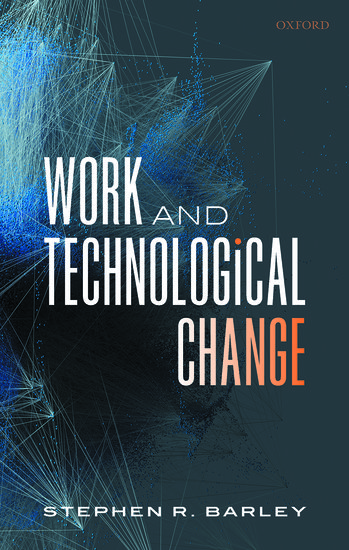
Member Publication: Work and Technological Change

Please check out the recent publication by OOW member Stephen R. Barley.

Barley, Stephen R. 2020. Work and Technological Change. Oxford University Press.

Here is a short description of the book:

In recent years a growing number of commentators have declared that we are at the beginning of a technical revolution that will see profound changes in the way we live and work. Yet what constitutes a technological revolution, and what logic supports how successive technological revolutions have unfolded in Western societies? How do technologies change organizations and what are the implications of intelligent technologies for work and employment?

Here, Stephen R. Barley reflects on over three decades of research to explore both the history of technological change and the approaches used to investigate how technologies are shaping our work and organizations. He begins by placing current developments in artificial intelligence into the historical context of previous technological revolutions, drawing on William Faunce’s argument that the history of technology is one of progressive automation of the four components of any production system: energy, transformation, transfer, and control technologies. He then considers how technologies change work, and when those changes will and will not result in organizational change. In doing so he lays out a role-based theory of how technologies produce changes in organizations. He then tackles the issue, alongside Matt Beane, of how to conceptualize a more thorough approach to assessing how intelligent technologies, such as artificial intelligence, can shape work and employment. They identify the main reasons why the current state of research on intelligent technologies in the workplace is inadequate, and provide pointers on how empirical studies in this area may, and must, be improved. He concludes with a discussion with his long-time colleague Diane Bailey about the fears that arise when one sets out to study technical work and technical workers, and the methods that they, and future ethnographers, can use for controlling those fears.

You can find more about the book and buy it on the Oxford University Press website.

OOW Virtual Event: CAREERS BEYOND ACADEMIA

Organizations, Occupations & Work
CAREERS BEYOND ACADEMIA

Discussions with OOW Researchers Working in
Government · Policy · Think Tanks · Research · Industry

Wednesday, February 10, 1:30-5:00 pm Eastern Time
CLICK TO REGISTER

PANEL I – 1:30-2:30pm
OOW IN GOVERNMENT, POLICY AND THINK TANKS

Leslie Hinkson (PhD Princeton University), The League of Conservation Voters
Steve Nuñez (PhD Stanford University), Jain Family Institute
Shelly Steward (PhD UC-Berkeley), Aspen Institute
Lindsay Owens (PhD Stanford University), Groundwork Collaborative

PANEL II – 2:45-3:45pm
OOW IN RESEARCH INSTITUTES & NON FACULTY ACADEMIC JOBS

George Hobor (PhD University of Arizona), Robert Wood Johnson Foundation
Caren Arbeit (PhD University of Minnesota), RTI International
Chris Bourg (PhD Stanford University), Director of Libraries MIT

PANEL III – 4:00-5:00pm
OOW IN INDUSTRY & VENTURE CAPITAL

Susan Biancani (PhD Stanford University), Airbnb
Tina Park (PhD Brown University), Partnership on AI
Rachael Ferguson (PhD Princeton University), To.org
Phaedra Daipha (PhD University of Chicago), Allstate

Awards: ASA Science, Knowledge and Technology (SKAT) Section Awards in the Spirit of Anti-Racism

Two new awards from the ASA Science, Knowledge and Technology (SKAT) section in the spirit of anti-racism—the Ida B. Wells-Troy Duster award and the Emancipatory Practice in SKAT award. Link for information: https://asaskat.com/2020/12/24/skat-section-announces-call-for-nominations-for-two-new-awards-established-in-the-spirit-of-anti-racism/

These awards welcome nominations and self-nominations of BIPOC scholars who are not currently members of the SKAT section (the prizes come with section membership if the winner is not currently a member).

Call for Papers: Special Issue of the Journal of Professions and Organization

Special Issue of the Journal of Professions and Organization: Diversity and Inclusion in Changing Professional Organizations

Editors:
Swethaa Ballakrishnen, University of California, Irvine
David Brock, Ben-Gurion University
Elizabeth Gorman, University of Virginia

Contemporary scholars have shed considerable light on processes of gender, racial-ethnic, and social class inequality in traditional professional organizations. Yet much has happened over the past two or three decades to reshape contexts for professional services, as well as the kinds of individuals who populate them. Alongside older organizational forms, there have been shifts to institutionalize new kinds of work resulting in larger and more bureaucratic organizational logics across professional fields. Many have established different kinds of transnational presences with continuing implications for the interrelated relationships between the local and the global across sites. Liberalized regulatory structures in many countries permit new organizational structures and forms of ownership. Artificial intelligence and information technology have replaced and transformed the work that professionals once have done and/or need to do much longer. New occupations that lack longstanding professional traditions, such as data scientists and project managers, are now providing “professional” knowledge-based services. These structural changes have, in turn, had important effects on individual capacities, outcomes, and experiences. At the broadest levels, inequality in income, status, and autonomy within professions has grown. At the same time, there have been new kinds of inequities buttressed as progress, and new rewards to interactional capital. The demographics of the kinds of individuals who seek (and are sought within) these professional milieus are changing, strategic corporate investments as they relate to global social movements have begun to offer new kinds of opportunities, and these changes have resulted in corresponding changes within professional experiences and environments.

What do these myriad changes and movements across different levels of analysis mean for gender, racial ethnic, class, and other forms of difference and inequality in professional organizations? At the individual level, do the same mechanisms of bias and exclusion previously identified in traditional professional service firms—such as stereotyping and preference for social similarity—continue to affect career outcomes as before? Do these changes have different implications for different demographic groups, or in different geographic sites? What career strategies do individual professionals utilize as they seek to navigate these changing waters? At the organizational level, what practices and structures promote or hinder diversity and inclusion? How have professional organizations sought to manage their increasing diversity? Which deliberate interventions are most effective, and which conflict with other organizational practices and goals? How, if at all, have clients influenced professional organizations’ efforts with respect to diversity and inclusion?

To address these and related questions, we invite scholarly papers from a wide range of disciplines and academic perspectives. We welcome submissions that address different levels of analysis (individual, firm, interactional, field) and make use of a variety of qualitative and quantitative methods. We especially encourage authors who investigate new forms of inequality, new managerial and organizational approaches to diversity and inclusion, and research on sites that are transnational, comparative, and/or global. If you have questions about whether you project might be a fit, please reach out to one or more of the guest editors (sballakrishnen@law.uci.edu, dmb@bgu.ac.il, eg5n@virginia.edu).

Deadline for full papers: June 15, 2021 Submit via: http://mc.manuscriptcentral.com/jpo

For more information about Journal of Professions and Organization see academic.oup.com/jpo/pages/why-submit