Two New Publications

Hello, here are two new publications from OOW members!

Ghaziani, Amin. 2025. “The Cultural Field of Queer Nightlife: Organizations, Artists, and Curatorial Activism.” The Sociological Quarterly

ABSTRACT: Queer nightlife is recognized by humanists as an artistic project, while social scientists use it more often as a case to examine deviance and regulatory control, macro-structural inequities, substance use, and sexual violence. In this article, I invite researchers to prioritize culture and creativity in theoretical frameworks of nightlife. Based on 112 interviews about underground parties in London that have arisen as gay bars close, I argue that, more than just an art form, queer nightlife is a cultural field. The conceptual shift from form to field accents the organizational plurality of nightlife, relational artmaking practices, and the aesthetics of activism. While these themes have been described by others—and they are by no means exhaustive—I use them to explain broad associations between art and event-based nightlife scenes in the context of community-level disruptions.

Neeraj Rajasekar, Evan Gunderson, and Annika Wilcox. 2025. “The Language of “Diversity” or “DEI”? Exploring Job Titles of Diversity Professionals in US Institutions of Higher Education.” Sociological Forumhttps://doi.org/10.1111/socf.13047

ABSTRACT : Diversity discourse and related policy have been common in US higher education, and many such institutions employ diversity professionals. As diversity has historically been a contested concept, the language schools use to articulate diversity can greatly shape the discursive environment and work faced by diversity professionals, especially in the current moment of regular political attacks on diversity and diversity, equity, and inclusion (DEI) offices in US higher education. This study analyzes the language of diversity in US higher education via analysis of diversity-related job titles. We examine job title data collected from thousands of colleges and universities across the country over an 18-year period, with special attention to educational institutions’ use of “diversity” versus “DEI” terminology. We also analyze how institutional characteristics and contextual factors are associated with language in diversity-related job titles. We find that te language of DEI became substantially more prominent over time, rising steadily from 2015 through 2022. While this may change in the near future, our study illustrates that DEI language had some momentum in American institutions of higher education (IHEs) in the past decade. Notably, schools’ language choice has little association with institutional characteristics or contextual factors, which has implications in a moment where anti-DEI politics and policy are affecting IHEs around the country. We discuss our analysis in the context of the current political-legal landscape and consider directions for future research examining the language of diversity and DEI in US society.
New Publication: “Class identity vs intersectional solidarities: Divergent models for organizing gig workers in Seoul and Toronto” by Youngrong Lee

Lee, Youngrong. (2025). Class identity vs intersectional solidarities: Divergent models for organizing gig workers in Seoul and Toronto. International Journal of Comparative Sociology,  online first. https://doi.org/10.1177/00207152241312904

ABSTRACT

Studies indicate that gig workers, one of the leading groups revitalizing labor movements globally, have organized by diverging from traditional union strategies. How do they achieve this in diverse local contexts? Drawing on 21 months of international ethnographic fieldwork with gig workers’ unions in Seoul and Toronto, this article examines how and why these two unions develop different strategies for addressing critical crises. Comparative analysis reveals that while the shared labor process and the multinational parent company drive the unions toward new unionism, different worker subjectivities are emphasized by each union based on specific axes of oppression: working-class citizen men in Seoul and racialized immigrants in Toronto. These union orientations are linked to the unions’ distinct histories, including the biographies of founding members. My argument is twofold. First, to better understand rising gig workers’ organizing efforts around the globe, we must consider both global and local contexts. While gig labor processes push gig workers’ unions to move away from traditional union tactics, two key local factors—the workforce’s demographic makeup and union histories—shape their divergent models. Second, it is critical to understand the process of cultivating solidarity—not only building solidarity itself but also deciding which groups to be in solidarity within the local context.

CfA: “Housing, Illegality and Criminal Actors” Workshop

Dear colleagues,

In the context of the ongoing global housing crisis, we (Elena Butti and I) organise a Paper Development Workshop titled “Housing, Illegality and Criminal Actors” on September 9 and 10, 2025, which will take place at the Geneva Graduate Institute, in collaboration with the ethnographic institute, emlyon business school.

Our ambition is to discuss and provide developmental feedback on ethnographic and qualitative papers exploring the entanglement of housing, illegal practices, and criminality through an interdisciplinary perspective (e.g., Anthropology, Sociology, Organization Studies, Urban studies).


The full CFP is available here: https://oce.em-lyon.com/housing-illegality/ . Deadline for abstracts is March 31st!

Best wishes 

Guillaume Dumont

Associate Professor of Anthropology. 

Director, Ethnography Institute

emlyon Business School & OCE Research Center

https://www.guillaumedumont.eu

New Publication: “Sousveillance Work: Monitoring and Managing-Up in Patrimonial Hollywood” by Julia M. Dessauer

Dessauer, J.M. Sousveillance Work: Monitoring and Managing-Up in Patrimonial Hollywood. Qual Sociol (2025). https://doi.org/10.1007/s11133-024-09580-y

Abstract: How do workers come to know what their bosses need and want? This paper shows how laborers in patrimonial work environments learn to serve their bosses through bottom-up observation, rather than top-down instruction. The author uses the case of assistants in Hollywood to introduce the concept of sousveillance work, which is the labor of monitoring, anticipating, and fulfilling a boss’s mutable needs and wants. Drawing on 60 + interviews with professionals in Hollywood, the author reveals how sousveillance work helps assistants manage-up and mitigate volatility wrought by their patrimonial superiors. The concept of sousveillance work adds to research on labor and uncertainty in creative industries, and also helps to reveal how patrimonial systems are sustained in contemporary work environments.


New Publication: “The intergenerational reproduction of self-direction at work: Revisiting  Class and Conformity” by Kaspar Burger, Francesca Mele, Monica Johnson, Jeylan Mortimer & Xiaowen Han

Kaspar Burger, Francesca Mele, Monica Johnson, Jeylan Mortimer, and Xiaowen Han. 2025. “The intergenerational reproduction of self-direction at work: Revisiting Class and Conformity.”  Social Forces. Online First https://academic.oup.com/sf/advance-article/doi/10.1093/sf/soaf016/7996444?utm_source=advanceaccess&utm_campaign=sf&utm_medium=email

Abstract: In his path-breaking monograph, Class and Conformity, Melvin Kohn reasoned that parents prepare their children for the same conditions of work that they themselves experience. Kohn and his colleagues’ research focused on the influence of parental self-direction at work on parental child-rearing values and practices, as well as the self-directed values of children. The intergenerational transmission of occupational self-direction from parents to the succeeding generation of adult children, strongly implied by Kohn’s analysis, has not been empirically tested. Using two-generation longitudinal data from the Youth Development Study (N = 1139), we estimate a structural equation model to assess the intergenerational continuity of occupational self-direction. We find evidence supporting a key inference of Kohn’s analysis: that self-direction at work, a primary feature of jobs of higher social class standing, is transmitted across generations via self-directed psychological orientations, operationalized here as intrinsic work values. Intrinsic values also significantly predicted second-generation educational attainment, contributing further to the reproduction of socioeconomic inequality. The findings enhance understanding of the intergenerational transmission of advantage.

YDS data are publicly available at the Inter-University Consortium for Political and Social Research archive, University of Michigan (ICPSR 24881).

WORK2025 Conference “Work in the Era of Unruly AI” from August 20-22, 2025 in Turku, Finland (also online)

The multidisciplinary, international WORK2025 conference is from August 20-22, 2025, at the University of Turku and online. WORK2025 offers 19 exciting research streams, five inspiring keynote talks, and nice breaks between the sessions to share knowledge, research results, and discuss new directions in research.

The main theme of WORK2025, “Work in the era of unruly AI,” will explore the “unruliness” of AI in contemporary working life. WORK2025 calls upon presentations and posters to address the main theme and various issues related to work and working life. WORK2025 welcomes abstracts from a wide variety of interdisciplinary, empirical, and theoretical perspectives.

Check out the streams and submit your abstract no later than February 20, 2025 at www.work2025.fi!

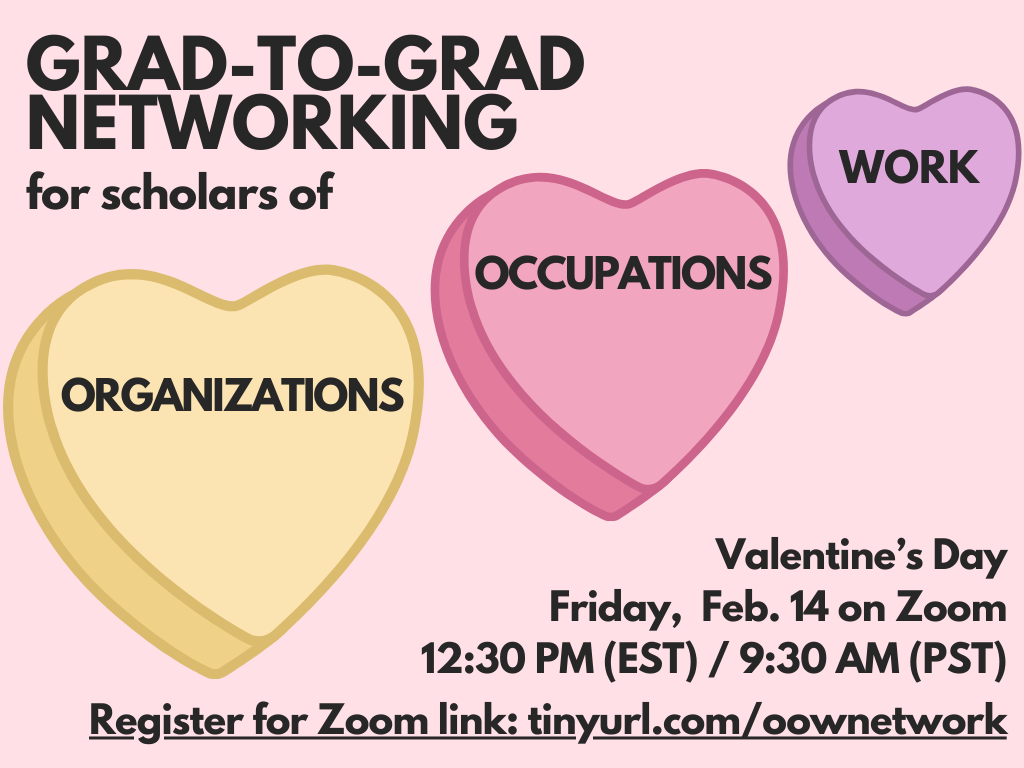
Grad-to-Grad Networking

Grad-to-Grad Networking for Scholars of Organizations, Occupations, and Work

February 14, 2025

12:30-1:30 PM (EST) / 9:30-10:30 AM (PST)

Zoom (registration at tinyurl.com/oownetwork required to receive link)

This virtual event is an opportunity for graduate students who study organizations, occupations, and work to meet peers with similar interests. The event is open to any graduate student with these interests; membership in ASA or the OOW section is not required. 

Research shows that lateral, peer-to-peer relationships are a meaningful resource for people building their careers. We hope this event can be a springboard for further in-person or virtual collaboration, information-sharing, and connection. Who knows? You might make a new friend, meet a new co-author, or just get more comfortable talking to others about your research.

Register to receive the Zoom link at: tinyurl.com/oownetwork. If you have any questions, please contact Ewa Protasiuk (ewa.protasiuk@temple.edu) or Victoria Zhang (vzhang3@mit.edu).

Call for Submissions

2025 ASA Thematic Roundtable on Organizing Informal Workers (Development Section)

Katherine Maich and Chris Tilly are organizing a Thematic Roundtable on Organizing Informal Workers at ASA 2025, as one roundtable within Sociology of Development. Mobilizations of informal workers, those lacking the legal and social insurance protections of standard workers, have become increasingly important, especially as more of the world of work informalizes. What does this mean for the future of work overall? We welcome empirical and theoretical, qualitative and quantitative work from any region of the world. Contributions from PhD students and junior scholars are particularly welcome.

To submit a paper, please do both of the following: (1) submit a paper or extended abstract to the Sociology of Development Roundtables through the regular ASA portal ahead of the February 26 deadline; (2) at the same time, email the paper or abstract to Kate at kmaich@tamu.edu. For any questions, please contact kmaich@tamu.edu.

New Publication

Here is a new publication from our OOW section member:

Wilcox, Annika. 2025. “Conforming Critical Diversity: Voicing Diversity for Equity in an Organizational Inequality Regime.” Sociological Focus 58(1). https://doi.org/10.1080/00380237.2024.2433524

ABSTRACT: Diversity is a contested notion: it can be framed “uncritically,” as all differences that benefit privileged groups, or “critically,” as categorical inequalities that must be addressed to advance equity. While uncritical diversity is broadly legitimated, critical diversity is often socially suppressed, particularly in racialized and gendered workplaces. Prior research elucidates how organizational actors advance uncritical (e.g. colorblind) diversity yet pays little attention to how everyday employees voice critical diversity in white-male-dominated work contexts that politicize matters of inequality. I address this concern via analysis of an extreme case: a large, U.S.-based technology company. Drawing on in-depth interviews with employees, I demonstrate that individuals strategically negotiate critical and uncritical meanings of diversity in conversation by conforming critical diversity, which involves (1) defining diversity broadly yet centering categories of inequality, (2) offering critical and uncritical justifications of diversity, and (3) couching critical justifications in individualistic language. These practices uphold status-quo-reproducing diversity narratives while also generating more critical arguments than expected based on prior research. Results suggest the importance of studying how the interactional spaces of organizations and workplaces constrain and enable individuals’ discussions of diversity. If organizations redefined cultural norms governing diversity-related conversations, they might see greater results from formal diversity initiatives.

Special Issue Call for Papers OOW

Special Issue: The Precarity of Work and Life: How Insecurity Equalizes and Stratifies People’s Experiences

Submission deadline: Tuesday, September 2, 2025

In 2023, an opinion piece in the New York Times posed a question: “why does everyone feel so insecure?” As the article delineates, “insecurity” is frequently described as the defining characteristic of our contemporary lives. However, despite the wide use of this concept in public debates as well as in the social sciences, socio-economic insecurity — and, to a lesser extent, its close cousin, “precarity” — have been subjected to very little theoretical conceptualization and/or dedicated research that seeks to systematize and concretize insecurity as a field of study. Our special issue aims to resolve this absence, with a particular focus on how socio-economic insecurity relates to the maintenance, reconfiguration, or legitimation of inequality.

Insecurity sets up an important puzzle for the social sciences: on the one hand, insecurity is felt by “everybody,” as Astra Taylor suggests in the New York Times, or at least a large and growing portion of the population. On the other, insecurity and precarity are the products of an economy that is increasingly unequal. In order to solve this puzzle, sociologists need to further investigate how experiences of insecurity vary and the ways in which economic and cultural factors shape different varieties of insecurity. We ask: Is everyone really experiencing insecurity? How is insecurity related to people’s structural conditions?

In order to address this puzzle, we welcome articles that address all aspects of socio-economic insecurity that go beyond orthodox economic framings and that can lead to empirical advancements, as well as theoretical developments, in how we understand insecurity vis-à-vis inequality. We invite submissions that use diverse methodological approaches, e.g. that explore subjective experiences of insecurity through in-depth qualitative or ethnographic research, that investigate generalizable or cross-national trends through quantitative data-based analyses, or that engage with mixed methodologies. We are particularly interested in sociological studies that address the following aspects of insecurity:

Topics for this call for papers include but are not restricted to:

·  Research on insecurity that moves beyond a limited conceptualization of insecurity and precarity as primarily related to employment to one that engages with the financial aspects of people’s instability, the relationship between employment and finances, as well as the unequal ways in how people negotiate socioeconomic uncertainty in their lives overall. What are the connections between work precarity and insecurity in livelihoods? How do the manifestations of insecurity differ nationally and globally in various spheres of individuals’ lives (e.g. housing, food consumption, debt and finance)? How is insecurity related to intersectional inequalities pertaining to class, gender, race/ethnicity and sexual identity?

·  Studies that employ an understanding of socio-economic insecurity that goes beyond a purely (macro)economic focus or the use of “objective” economic measures. We aim to deepen the focus on the subjective experiences of insecurity that are often linked to the decline in social status of previously secure social strata (e.g. the squeezed middle classes). What is the relationship between the objective and subjective insecurity experienced by individuals? What is the temporal construction of insecurity and how is present insecurity shaped by past experiences and projections/expectations of future conditions? How does insecurity contribute to redefining class positions and class boundaries? How do increases and decreases in insecurity influence social status threat or social status gains across the globe?

Guest Editors:
Dr. Lorenza Antonucci
University of Birmingham
United Kingdom

Dr. Elena Ayala-Hurtado
Princeton University
United States