New Publication: “Jurisdictional Gerrymandering: The Authority of Problems without Solutions” by Shira Zilberstein

Zilberstein, Shira. 2026. “Jurisdictional Gerrymandering: The Authority of Problems without Solutions.” Social Problems. doi:10.1093/socpro/spag024

Abstract: This paper develops the concept of jurisdictional gerrymandering to explain how professionals selectively invoke boundaries around their expertise to frame their role and maintain authority in solving problems that extend beyond their jurisdiction. Drawing on a study of artificial intelligence (AI) model development for healthcare, I analyze how AI practitioners position their work in relation to health equity, an issue they acknowledge cannot be solved through technology. Rather than claiming full authority over equity solutions or deferring to other domains, AI practitioners engage in jurisdictional gerrymandering by critiquing, projecting, and dissolving jurisdiction for different aspects of defining and solving health equity. This process enables them to retain authority to participate in health equity problem solving through moral alignment without accountability for solutions. In contrast to jurisdictional models of professional authority or networked expertise, jurisdictional gerrymandering unbundles defining and solving problems. It reveals a key mechanism through which authority is maintained without asserting control or claiming to be able to achieve solutions. Jurisdictional gerrymandering enables problem frames to continually serve as justifications for technological projects and expert interventions regardless of solutions, shedding light on tensions between innovation, expertise, and responsibility for social problems.

Shira Zilberstein is a PhD candidate in sociology at Harvard University and a fellow in the Science and Technology Studies program at the Harvard Kennedy School. Her research focuses on cultural sociology, science and technology studies and organizations, as well as theory and methods. She is interested in the production, interpretation and evaluation of ideas and the dynamics between hegemonic and counter-hegemonic forms of knowledge in institutional and technical settings. To this end, she has conducted research on grassroots artists, international non-governmental organizations, American college students, academics and journalists. Her dissertation focuses on applied interdisciplinary research collaborations in the field of artificial intelligence. The project studies the ways in which social impact is understood and structured by organizational incentives and decision-making processes that define and seek to address social needs.

New Publication: “The (State–Private) Ties That Bind: Status, Interactions, and Economic Development in India” by Aruna Ranganathan & Laura Doering

Ranganathan, Aruna, and Laura Doering. 2026. “The (State–Private) Ties That Bind: Status, Interactions, and Economic Development in India.” Sociology of Development 1–31. doi:10.1525/sod.2026.2893447.

Abstract: Governments often collaborate with the private sector to design and implement major economic initiatives. In studying such state–society collaborations, sociologists tend to focus on how institutional contexts shape outcomes. Although this institutional approach has been highly generative, it can overlook important micro-level interaction patterns between state and private-sector actors that also affect economic outcomes. In this study, we examine how bureaucrats in the Indian government interacted with private-sector representatives to design and implement an industrial crafts park. Drawing on ethnographic observations, interviews, and supplemental survey data, we show how bureaucrats’ status biases in favor of certain private-sector actors produced interaction patterns that blinded them to fatal flaws in the project’s design and ultimately contributed to its dramatic failure. By bringing an interactionist lens to state–society economic engagements, this study reveals how interaction patterns can aggregate to shape large-scale development outcomes. More broadly, it highlights an important but undertheorized pathway through which bureaucrats may inadvertently reinforce social stratification through the very projects intended to reduce economic inequality. We suggest that an interactionist approach to state–private collaborations and policy design can contribute to efforts to address global poverty.

Aruna Ranganathan holds the Dong Koo Kim Chancellor’s Chair in Social Entrepreneurship and is an Associate Professor at the UC Berkeley Haas School of Business. Prof. Ranganathan is also affiliated with the Sociology department and the Institute for Research on Labor and Employment at UC Berkeley. She was formerly an associate professor of organizational behavior at Stanford University. Ranganathan spent her childhood in the Middle East, India, and Singapore before graduating with honors from the University of British Columbia’s Sauder School of Business with a BCom in organizational behavior and human resources. She also received an MS in international and comparative labor from Cornell University’s School of Industrial and Labor Relations and an MS/PhD in management from MIT’s Sloan School of Management.

Laura Doering is an Associate Professor of Strategic Management and is cross-appointed in the Department of Sociology. As an economic sociologist, she examines how interactions and social psychological processes shape outcomes for households, organizations, and markets. Her research has been published in the American Journal of Sociology, American Sociological Review, Sociological Science, Sociology of Development, and Journal of Business Venturing. Professor Doering’s research and writing have appeared in The New York Times, BBC News, The Globe and Mail, Salon, and other outlets.

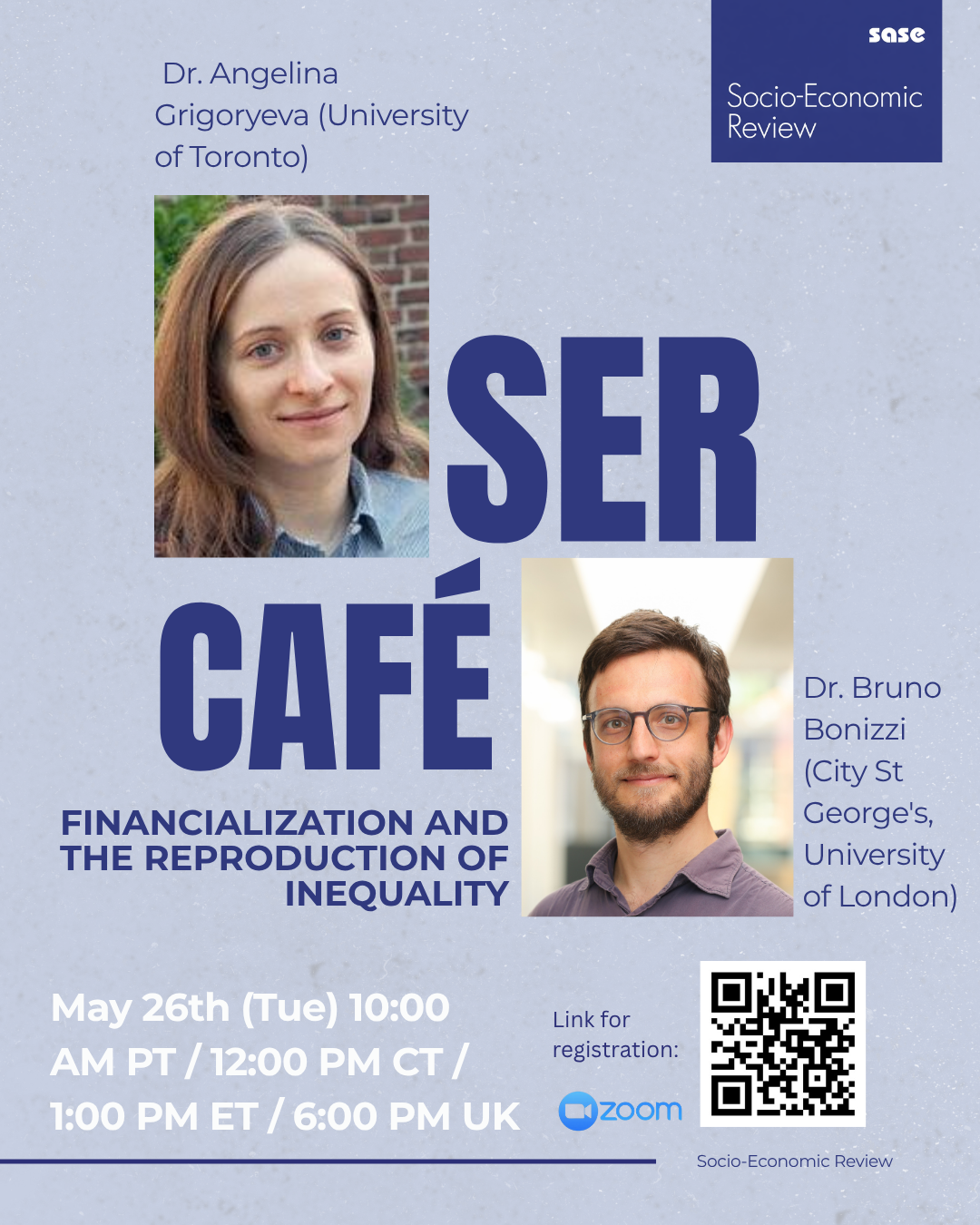
Announcement: Join the Socio-Economic Review (SER) Café Event on May 26, 2026, via Zoom

Join us for the next SER Café event on the theme “Financialization and the Reproduction of Inequality.” This one-hour Zoom session will feature a discussion with recent Socio-Economic Review authors Angelina Grigoryeva (University of Toronto), and Bruno Bonizzi (City St George’s, University of London).

In her 2025 article “The shift to stock-based compensation and gender inequality in wealth in the United States”, Angelina Grigoryeva uses Survey of Consumer Finances data to show that stock-based compensation, though a more powerful vehicle for wealth accumulation than regular wages, disproportionately benefits men—especially at the top of the wealth distributions.

The second article “Pension financialization and workplace pension wealth inequality: evidence from Britain” by Bruno Bonizzi, Hulya Dagdeviren, and Benjamin Tippet, examines how the shift from Defined Benefit to Defined Contribution pensions has reshaped pension wealth inequality in Britain. They identify four key channels through which DC pensions aggravate inequality—the inequality of pension contributions, lack of redistributive mechanisms, the compounding effects of missed contributions, and unequal capacity for financial risk. Bruno Bonizzi will join the discussion to represent the author team.

The event will take place on May 26, 2026 (Tuesday) at 10:00 AM PT / 12:00 PM CT / 1:00 PM ET / 6:00 PM UK time.
Please register at this link

As with all SER Café events, this session will prioritize dynamic conversation with the authors over lengthy presentations. Come ready to engage, ask questions, and discuss. Our authors look forward to your questions and comments.

Team SER Café (Ezgi, Fan, and Kyungmo)
Socio-Economic Review

Announcement: Digital Statecraft and Political Economy in China Conference at UC Berkeley on May 8-9

Digital Statecraft and Political Economy in China Conference
May 8-9, 2026
University of California, Berkeley
Conference website: www.dspeconference.com

Digital technologies, from big data, AI, and algorithmic governance to cloud computing and data infrastructures, are transforming how states drive development, govern society, exercise authority, and compete globally. This conference brings together fourteen in-depth qualitative studies that examine how state actors deploy digital tools in practice and how political institutions shape technological development.

Focusing on China as a strategically important and empirically challenging case, the conference showcases new ways to open the “black box” of digital governance beyond dominant computational methods and macro-level analyses. It advances a sociological agenda by showing how digitalization is reshaping core theories of the state and political economy, reconfiguring state capacity, bureaucratic operations, platform governance, and government–firm relations, while moving beyond conventional “digital authoritarianism” frameworks to foreground on-the-ground politics, institutional frictions, and organizational processes.

The papers engage broader debates on the transformation of the state under digitalization, the political economy of data, platforms, digital industries, and the shifting terrain of geopolitical competition.

Interdisciplinary and international in scope, the conference features scholars from four continents. It will be held at UC Berkeley and is open to the public, with both onsite and online participation. Breakfast and lunch will be provided for onsite attendees. Registration is required; online access details will be shared upon registration.

Register here:
https://docs.google.com/forms/d/e/1FAIpQLSdqfT0H_0j6GL2RT50n_AQgHMcU37MKBoHqxDcDI0hv0knFpQ/viewform

Organizers:
Yan Long, UC Berkeley, Department of Sociology
Le Lin, University of Hawai‘i at Mānoa, Department of Sociology
Zhifan Luo, McMaster University, Department of Sociology

Sponsors:
UC Berkeley Sociology Department, Berkeley Economy and Society Initiative, Fudan-UC Center

Contact
For questions regarding the conference, registration, or attendance, please contact the coordinator, Zhehang Zhang (UC Berkeley, Department of Sociology) at zhehang@berkeley.edu

Call for Papers for Special Issue: “Networks of Expertise: New Approaches to Study Professions and the Social Organization of Expert Labor”

The Journal of Professions and Organization has a call for papers for a special issue on “Networks of Expertise: New Approaches to Study Professions and the Social Organization of Expert Labor.”

This special issue is dedicated to empirical and theoretical contributions that harness the innovative potential of the expanded lens of expertise networks. It particularly welcomes submissions that explore the specific contributions of this approach to the study of experts, professions, organizations, and past as well as ongoing shifts in the social organization of expertise. This includes contributions that elaborate on, develop, apply, or critique the network of expertise approach, and/or bring it into conversation with existing approaches to foster a deeper understanding of both continuities and discontinuities in the social organization of expertise. Contributions from varied national contexts, institutional and organizational settings, and types of expertise are equally encouraged. Questions of interest include, but are not limited to:

  • How do different groups of experts coordinate for approaching expert tasks and problems?
  • Under what conditions is trust in experts sustained or lost? Which types of performative work and expertise network structures are better suited to securing trust in expertise?
  • What are the societal preconditions and consequences of the changing nature of expertise?
  • How do organizations enable and constrain (alternative) expert performance, and what impact do new organizational demands and recent organizational forms, such as platform organizations, have?
  • What are the changes in the organization of expert labor following the introduction of new technologies (e.g., new energy sources and GenAI)? When is AI used to monitor or control expert work, when does it create new markets for expertise, and under what conditions does it become an alternative to professionalized expert opinion? 
  • What theories help us to better grasp the phenomenon of networked expertise, and what potential does the study of expertise offer for theorizing (including theorizing from so-called neglected cases (Krause 2021, 2024)?
  • What methodological “tools of the trade” are helpful for comprehensively mapping networks of expertise?

Timeline and Information

Abstract deadline: July 15, 2026 (1-2 pages)

Invitation from the special issue editors to submit full manuscripts: September 15, 2026

Full paper submission: March 15, 2027 (up to 10,000 words including all references, tables, and appendices)

Please submit abstracts to the special issue editors for initial review. When submitting full manuscripts, please follow the submission guidelines of The Journal of Professions and Organization and indicate that the manuscript is intended for the special issue “Networks of Expertise: New Approaches to Study Professions and the Social Organization of Expert Labor.”

For further information, authors are encouraged to contact the special issue editors:

Netta Avnoon (navnon@uwo.ca)

Désirée Waibel (desiree.waibel@unilu.ch)

Gil Eyal (ge2027@columbia.edu)

You can find more information at the Journal of Professions and Organization.

Featured on Work in Progress: Steven Vallas Reviews Kathleen Thelen’s Attention Shoppers!

We invite you to read “Political Roots of the Amazon Economy: A Review of Kathleen Thelen’s Attention Shoppers! by Steven Vallas. This review highlights the book’s major contributions, with particular attention to its implications for debates over affordability in American society.

Book Overview: The United States is widely recognized as the quintessential consumer society, one where huge companies like Walmart and Amazon are famous for enticing customers with cheap goods and speedy delivery. Attention, Shoppers! traces the origins and evolution of American retail capitalism from the late nineteenth century to today, uncovering the roots of a bitter equilibrium in which large, low-cost retailers dominate and vast numbers of low-income families now rely on them to make ends meet.

Offering a comparative perspective on the history of American political economy, Kathleen Thelen shows how large-scale retailers in the United Kingdom, Germany, Denmark, and Sweden faced a far less hospitable regulatory environment than companies in the United States, which enjoyed judicial forbearance and often active government support. As American companies grew in scale and scope, they assembled an ever-expanding political coalition that could be weaponized to head off regulatory efforts, leveraging their market strength to squeeze suppliers and workers and even engaging in outright rule-breaking when they encountered resistance.

Placing the rise of the Amazon economy in a broader comparative-historical context, Attention, Shoppers! reveals how large discount retailers have successfully exploited a uniquely permissive regulatory landscape to create a shopper’s paradise built on cheap labor and mass consumption.
Book overview reprinted from Princeton University Press.

Kathleen Thelen is Ford Professor of Political Science at the Massachusetts Institute of Technology. Her work focuses on the political economy of the rich democracies, with a current emphasis on the study of American capitalism in comparative perspective. She is the author, among others, of Attention Shoppers! American Retail Capitalism and the Origins of the Amazon Economy (Princeton University Press, 2025), Varieties of Liberalization and the New Politics of Social Solidarity (2014) and How Institutions Evolve(2004), and co-editor of The American Political Economy: Politics, Markets, and Power (with Jacob Hacker, Alexander Hertel-Fernandez, and Paul Pierson, 2022), Advances in Comparative Historical Analysis (with James Mahoney, 2015), and Beyond Continuity (with Wolfgang Streeck, 2005). Her awards include the  Friedrich Schiedel-Award for Politics & Technology (2020), the Aaron Wildavsky Enduring Contribution Prize (2019); the Michael Endres Research Prize (2019), the Barrington Moore Book Prize (2015), the Woodrow Wilson Foundation Award of the APSR (2005), the Mattei Dogan Award for Comparative Research (2006), and the Max Planck Research Award (2003). She was elected to the American Academy of Arts and Sciences in 2015 and to the Berlin-Brandenburg Academy of Sciences in 2009. She was awarded honorary degrees at the Free University of Amsterdam (2013), the London School of Economics (2017), the European University Institute in Florence (2018), and the University of Copenhagen (2018).

Dr. Thelen has served as President of the American Political Science Association (APSA), Chair of the Council for European Studies, and as the President of the Society for the Advancement of Socio-Economics. Thelen is a permanent external member of the Max Planck Institut für Gesellschaftsforschung (Cologne, Germany).

Steven Vallas is Professor Emeritus of Sociology at Northeastern University in Boston. Most of his research concerns the transformation of work, struggles over new technologies, and responses to the demands of the new economy. His books and articles have appeared in all the usual places. He is currently at work on an NSF-funded study of the algorithmic workplace, focusing on ride-hailing, home maintenance, courier, and caregiving platforms. He is also conducting research on logistics workers, with a particular focus on Amazon workers.

Call for Papers for the 3rd Equitable Opportunity Conference

3rd Equitable Opportunity Conference:

Diagnosing and Addressing Inequality Mechanisms

Call for Papers

May 15-16, 2026

Desautels Faculty of Management, McGill University, Montreal

Organizers: Lisa Cohen & HJ Jung (McGill) and Chris Rider (Michigan)

Submission Deadline: February 28, 2026

We use the term “equitable opportunity” deliberately. “Equitable” indicates circumstances in which no disparities result from “differential treatment” (i.e., unequal treatment yields different outcomes) or “disparate impact” (i.e., equivalent treatment yields different outcomes). “Opportunity” highlights possibilities to obtain an education or a job, launch a business, experience socioeconomic mobility, etc. that vary across people, time, and place. “Equitable Opportunity”, therefore, focuses us on understanding and addressing situations where differential treatment or disparate impact generate uneven distributions that violate our notions of equity.

The conference aims to:

  • Promote equity research on organizations that spans disciplines and fields, highlighting novel theories, methodologies, findings, and implications for research, practice, and policy.
  • Foster the exchange of ideas and practices among researchers, practitioners, and policymakers, bridging gaps between theory and practice.
  • Facilitate research collaborations between researchers and organizations interested in  collaborating on research projects, policymaking, and organizational interventions.
  • Feature multidisciplinary approaches to understanding the equity challenge that organizational leaders face as they try to be inclusive of diverse notions of fairness and justice. 

Preliminary Program Highlights

Keynote Address: Damon Phillips (Wharton)

Plenary Speakers: Laura Adler (Yale), Stephanie Creary (Wharton), Sonia Kang (Toronto), Zoe Kinias (Western Ontario), and András Tilcsik (Toronto)

  • Editors’ panel featuring editors from top journals like AMJ, ASQ, MS, and Organization Science.
  • Informal networking opportunities.
  • Pre-conference workshop for PhD students

Call for Presentations and Posters

Submissions are invited from faculty, doctoral students, and researchers on equity and opportunity in organizations.

Submission Guidelines

·       Contact name, affiliation/institution, and email address.

·       Names and affiliations of all contributing authors in order.

·       Presenter’s name, affiliation/institution, and email address.

  • Title of the presentation.
  • Short abstract (max 150 words) for the program.
  • Indicate your preference for presentation type:  (1) oral paper presentation; (2) poster presentation; or (3) either oral or poster.
  • Extended abstract (max 1,500 words) with sections: (1) Motivation & Research Question; (2) Theoretical Objectives, (3) Methodological Approach; (4) Data & Results (if applicable); (5) Intended Contribution; and (6) Relevance for the “Equitable Opportunities” Theme.

Submissions should be entered here. The deadline is February 28, 2026.

Conference submissions will be reviewed by the EOC Scientific Review Committee. Papers will also be considered for publication in a volume of Research in the Sociology of Organizations on this theme.

Pre-Conference Doctoral Student Workshop

Doctoral students may also apply to attend a doctoral student pre-conference workshop on the morning of Friday, May 15th.  Interested applicants should submit a CV and a statement of no more than two pages hereThe statement should specifically describe how their research addresses the concept of “equitable opportunities” and why they wish to participate.

Registration

This year, we will charge a nominal registration fee and offer fee waivers to scholars who lack funding to attend this conference. Information on how to register will be distributed after the paper submission deadline. Space will be limited but we hope to include attendees who do not submit papers.

Scholars at all career stages are encouraged to submit proposals. We also encourage submissions from practitioners who are interested in engaging researchers on the concept of equitable opportunities.

The conference will begin with lunch on Friday,  May 15th and will end about 5pm on Saturday, May 16th. For more information, please contact Chris Rider at riderci@umich.edu or Lisa Cohen at lisa.cohen2@mcgill.ca.

Announcement: Please Join Socio-Economic Review (SER) Café Event on Friday, January 30th, 2026 via Zoom!

Join us for an engaging SER Café event featuring a thought-provoking discussion with recent Socio-Economic Review authors, Tiago Vieira (European University Institute), Pedro Mendonça (Heriot-Watt University), Qi Song (Northwestern University), and Tiantian Liu (The University of Manchester).

The paper published by Tiago Vieira and Pedro Mendonça in 2025, The times, are they changing? Examining platform companies’ chameleonic labour process as a response to the Spanish Rey Rider, Tiago Vieira, Pedro Mendonça investigates the impact of Spain’s Ley Rider (Rider Law), which established a universal presumption of employment for platform couriers by highlighting platform companies as “institutional chameleons,” to underline their ability to adjust their operations to either comply with or circumvent new regulatory frameworks. Qi Song and Tiantian Liu published their study in 2025 called Transcending boundaries and breaking social safety nets: how digital platforms reorganize the market and exacerbate economic insecurity, Qi Song, Tiantian Liu to explore the platformization of the Chinese freight transportation sector, specifically the emergence of the Full Truck Alliance (FTA) by arguing that platforms have replaced traditional “relational infrastructures”—social networks based on trust and local ties—with centralized digital infrastructures.

The event will take place on Friday, January 30th, 2026, 8:00 AM PT / 4:00 PM GMT (UK) / 5:00 PM CET. Please register at this link: https://utexas.zoom.us/meeting/register/yewOixmESU6pA75inJbSeQ

As with all SER Café events, this session will prioritize dynamic conversation with the authors over lengthy presentations. Come ready to engage, ask questions, and discuss these critical contributions to the field. Our authors look forward to your questions and comments.

Team SER Café (Ezgi, Fan, and Kyungmo)

Socio-Economic Review

Paper Development Workshop on the Experience of Illegality | University of St. Gallen, Switzerland | Apr 1–2, 2026 | Abstracts Due Dec 15, 2025

PAPER DEVELOPMENT WORKSHOP (PDW)

The Experience of Illegality
Bodies, identities, moralities

April 1 & 2, 2026, Institute of Sociology, University of St.Gallen, Switzerland

Organizing committee
Loïc Pignolo, University of St.Gallen, Switzerland.
Guillaume Dumont, Ethnographic Institute, Emlyon Business School, France.

Abstract submission
Please send an abstract of 300 words and a short biographical note to gdumont@em-lyon.com and loic.pignolo@unisg.ch by December 15, 2025. Notification of acceptance will be sent by January 15, 2026. Papers must be submitted by March 15, 2026.

There is no registration fee, and we will cover the lunch on both days and the dinner on the first day. Additionally, partial grants for travel and accommodation can be provided to a small number of participants with limited resources. Please indicate if you require financial support.

Participation in the workshop is open to all upon registration.
For any additional details please visit: https://www.guillaumedumont.eu/illegality-pdw

Purpose and format
This PDW aims to provide guidance to researchers from various disciplines (e.g., sociology, anthropology, criminology, and organizational studies) at different stages of their careers, offering support in developing their papers. Invited discussants will help participants consider novel ways to utilize their data to craft a compelling narrative and to create a theoretical contribution based on these data in a collegial manner. The PDW will be structured as a two-day interactive workshop. Each author will be given 10 minutes to present the paper and 35 minutes for discussion. Two discussants will review each paper and provide developmental feedback to strengthen and improve the authors’ work. Furthermore, all authors must also commit to reading two selected papers before the workshop to provide additional feedback. 

We do not expect the papers to be polished and well-finished. Still, they should be sufficiently advanced to be reviewed by the discussants, build upon a strong empirical foundation, and demonstrate the potential to contribute to developing a broader understanding of the experience of illegality. Given the workshop’s aim, published papers will not be accepted.

Theme
Popular perceptions of illegality often stem from sensationalist portrayals in the media, movies, or TV shows. These accounts depict, at times, dangerous criminals, mafia-like and cartel organizations, and crime-ridden neighborhoods where simply visiting could lead to one’s demise. Likewise, they associate illegality with individuals who strive to stay under the radar, bending the rules for their own personal gain, disregarding laws, moral norms, or ethical considerations for themselves or others. Such accounts render illegality inherent to specific practices, activities, and individuals through their naturalization, for instance, due to personal traits, lifestyles, life trajectories, or the characteristics of a particular area. 

The ethnography of the daily experience of illegality, however, offers a very different picture, one that foregrounds the socio-cultural, as well as economic and political construction of illegality (Flores and Schachter 2018) and its multi-layered consequences for those subjected to these regimes. As migration studies demonstrated, illegality is “a form of juridical status, a sociopolitical condition, and a way of being-in-the-world” (Willen 2019:47). Illegality, in that sense, not only shapes the social world of individuals subjected to illegalization processes (e.g. Sigona 2012) but also has a profound impact on their inward parts. It is an eminently embodied, temporal, and subjective experience (Garza 2018; Gutiérrez-Cueli et al. 2024)—a construct that must be analyzed rather than reified or naturalized.

This call for papers takes as its structuring theme how illegality is experienced by people in the daily conduct of their lives. Specifically, we invite papers that focus on the intricacies between illegality and the bodies, identities, and moralities of those involved in illegal activities across illegal or legal markets. Methodologically, then, we expect contributors to employ ethnographic or, more broadly, qualitative research methods. This combination, we believe, is uniquely positioned to reveal the penetration of illegality in many aspects of the lives of workers, clients, consumers, or managers are subjected to it in ways that are most often invisible to external outsiders. We also expect these accounts of micro-level field dynamics to connect with broader, structural trends, as illegality, despite being experienced subjectively, is a socio-cultural, economic, and political construction with concrete implications. We further structure our inquiry into the experience of illegality around three main areas—bodies, identities, and moralities—to be explored either in relation to one another or independently, as well as across contexts: 

Bodies: We are interested in the embodiment of illegalization. Illegality, indeed, is not a mere label applied to people and, thus, external to them. Instead, it is profoundly embodied and enacted (Holmes 2023), as well as reacted to (Gonzales and Chavez 2012). Resultingly, we expect papers that address how illegality and illegalization shape the body, for instance, through imposing circumstances for life and work on people. Likewise, we are also interested in papers examining how the body can be played out and potentially instrumentalized due to this imposed condition, for instance, through specific bodily practices that derive from the illegalization or aim to avoid detection (Perrin 2018). Overall, we welcome proposals that address the embodiment of illegality in its various forms.

Identities: In a context where the legal is usually viewed as legitimate, illegality and illegalization carry consequences for individual and collective identities. Accordingly, we are interested in papers looking at questions such as how illegalization impacts self-representation across different spheres of life (e.g., work, leisure), how individuals gain respect and establish themselves through alternative means when navigating circumstances of illegality (Erickson, Hochstetler, and Copes 2019; Estrada and Hondagneu-Sotelo 2011), which coping mechanisms they develop to address illegalization, how the association of illegality with specific groups shapes the construction of collective identities, and how illegality nurture specific uncertain future that are imagined and enacted through these identities. 

Moralities: Illegality and illegalization are typically motivated and justified based on broader moral principles (Fassin 2012), over which governmental institutions have a monopoly and the power to enforce (Weber 1946). Given the multiplicity of moral orders (Boltanski and Thévenot 1991), we invite papers that examine how individuals and groups navigate the existence of multiple, coexisting moralities that may conflict due to illegality. We also expect papers examining how people contest the imposition of a broader moral order (Hübschle 2017; Paul Mmahi and Usman 2020), as well as how they negotiate among different moralities and express their discontent, for instance, through the emergence of advocacy groups contesting the banning of activities or reclaiming social justice (De Rond, 2025).

For any additional details please visit: https://www.guillaumedumont.eu/illegality-pdw
Announcement: Please Join Socio-Economic Review (SER) Café Event this Friday, November 14th, 2025 via Zoom!

Join us for an engaging SER Café event featuring a thought-provoking discussion with recent Socio-Economic Review authors, Matthew Clair (Stanford University) and Rachel Kim (Harvard University).

The paper by Matthew Clair and Sophia Hunt, “Moral reconciling at career launch: politics, race, and occupational choice?“, explores how young adults justify entering morally conflicting careers through narratives of lifting up, leveraging out, and leaning in. Rachel Kim investigates how tech workers’ trust in corporate ethics programs shapes their moral evaluations of their employers and work in “The internal effects of corporate “tech ethics”: how technology professionals evaluate their employers’ crises of moral legitimacy“.

The event will take place on Friday, November 14th, 2025, 8:30 AM Pacific Time / 11:30 AM Eastern Time / 5:30 p.m. Central European Time.

Please register at this link:
https://utexas.zoom.us/meeting/register/BT04tFChRJadD4eyDD17dw

As with all SER Café events, this session will prioritize dynamic conversation with the authors over lengthy presentations. Come ready to engage, ask questions, and discuss these critical contributions to the field. Our authors look forward to your questions and comments. 

Team SER Café (Ezgi, Fan, and Kyungmo)
Socio-Economic Review