New Publication: “Fuzzy Boundaries: A Mechanism for Group Accumulation of Advantage” by Dr. Heba Alex

Alex, Heba. 2025. “Fuzzy Boundaries: A Mechanism for Group Accumulation of Advantage.” Sociological Theory. Online first. https://doi.org/10.1177/07352751251378516

Abstract:
This article describes a strategic mechanism, fuzzy boundaries, that groups use to accumulate advantage. In contrast to the dominant view that rigid, well-defined boundaries maximize group rewards, I argue that ambiguity in membership criteria can, under certain conditions, more effectively secure and promote group benefits. Fuzzy boundaries are defined by two features: an intentionally ambiguous criterion for inclusion and the selective, inconsistent application of that criterion to adjust the insider-outsider line as needed. I illustrate the operation of fuzzy boundaries through a historical analysis of occupational boundary drawing in the nineteenth-century United States. Ultimately, the study offers a generalizable framework for understanding how strategic ambiguity in group boundaries can serve actors seeking to preserve privilege across domains, such as education, hiring, and professional accreditation. Unlike well-defined qualifications, the malleability of fuzzy boundaries often insulates them from legal challenge, making them an effective mechanism for maintaining social and institutional advantage.

Dr. Alex is a Teaching Fellow in the Department of Sociology at the University of Chicago, and studies topics related to evaluation, differentiation, and morality in diverse institutional contexts such as lower courts, rights, and occupational organizations.

At present, Dr. Alex is developing a book about the moral character clause (being of good moral character) in licensing laws in nineteenth-century America.  You can read an article that emerged from one aspect of this project here. Dr. Alex is also in the early stages of a comparative study examining how the moral clause relates to voting and jury rights during the same period.

Dr. Alex received their Ph.D. in Sociology from the University of Chicago in 2025. Before that, Dr. Alex obtained a B.A. in History from Sarah Lawrence College and an M.A. in Gender and Women’s Studies from UW–Madison. Dr. Alex’s professional journey includes a year at the International Center for Transitional Justice in New York and a Doctoral Fellowship at the American Bar Foundation.

Announcement: Call for Work and Family Researchers Network Early Career Fellowship Applications

The Work and Family Researchers Network (WFRN) is seeking applicants for its 2026-2027 Early Career Work and Family Fellowships.

The goal of the program is to help promising young scholars establish career successes and integrate them within the WFRN research community.

Fellows receive a 2026 membership in the WFRN, conference registration, and $250 to attend an Early Career Fellowship Preconference (June 17, 2026) and the 2026 WFRN Main Conference (June 18-20, 2026) in Montreal, Canada. To be eligible, candidates must have received their doctorate in 2023 or later and have yet to progress into tenured or secure senior-level positions. 

The deadline for applications is October 1, 2025.

Questions about the program can be addressed to the program co-directors, Nicole Denier (ngdenier@gmail.com) and Yang Hu (prof.yanghu@gmail.com).

Application submission information and further details on the Early Career Fellowship program can be found on this link: https://wfrn.org/early-career-fellowship/

New Publication: “Working-Class Structural Power, Associational Power, and Income Inequality” by Dr. Masoud Movahed

Movahed, Masoud. 2025. “Working-Class Structural Power, Associational Power, and Income Inequality.” Journal of Industrial Relations. Online first. https://doi.org/10.1177/00221856251326670

Abstract:
Under capitalism, workers have two sources of power: associational and structural. A vast body of social science research shows that workers’ power—often measured by union density—is associated with lower levels of income inequality. Drawing on a country-level, panel dataset for much of the post-World War II era (1960–2013), the author introduces a model of distributive outcomes that centers on the dual sources of workers’ associational and structural power. By differentiating the sources of workers’ power, the author examines the extent to which they bear on distributive outcomes across countries in the Global North. Using two-way fixed effects regression models, the author presents strong evidence that while workers’ associational and structural power are both statistically associated with lower levels of income inequality, it is workers’ structural—and not associational—power that drives egalitarian outcomes. Notably, counterfactual simulations demonstrate that, on average, structural power of the working class explains a gap up to approximately 4% in levels of income inequality over the past five decades across postindustrial countries.

Dr. Masoud Movahed’s research lies at the nexus of social stratification, economic, and political sociology. It integrates computational and quantitative methods with those of comparative historical methods in order to investigate the social-structural and institutional determinants of income and wealth inequality, both cross-nationally and within the U.S. context. More specifically, his research draws on panel data analysis, spatial econometrics, and machine learning tools, including both unsupervised clustering techniques and supervised learning algorithms. While Dr. Movahed employs computational methods, he retains a keen interest in comparative-historical methods, particularly event structure analysis (ESA), sequence analysis, and process tracing. More recently, Dr. Movahed has been part of collaborative projects that use survey experiments in U.S. contexts, alongside work in computational text analysis focusing on topic modeling and sentiment analysis.

Dr. Movahed’s papers have been published in Social Science Research, Journal of Industrial Relations, Spatial DemographyInternational Journal of Comparative SociologyJournal of International DevelopmentThe Sociological Quarterly, and Interface: A Journal for and About Social Movements. Beyond academic research, Dr. Movahed also contributes essays and commentary to public-facing outlets such as Foreign AffairsBoston ReviewWorld Economic ForumHarvard International Review, Yale Journal of International Affairs, and Al Jazeera.

Dr. Movahed has won awards from various sections of the American Sociological Association, including the Mathematical Sociology, Political Economy of the World-System Section, and Sociology of Development. He also received the Sabina Avdagic Early Career Scholar Prize from the Society for the Advancement of Socio-Economics (SASE).  He holds an M.A. from New York University and a Ph.D. from the University of Wisconsin–Madison, followed by a postdoctoral fellowship at the University of Pennsylvania.

2025 ASA OOW SECTION AWARDS

Congratulations to the 2025 award recipients for their achievements!

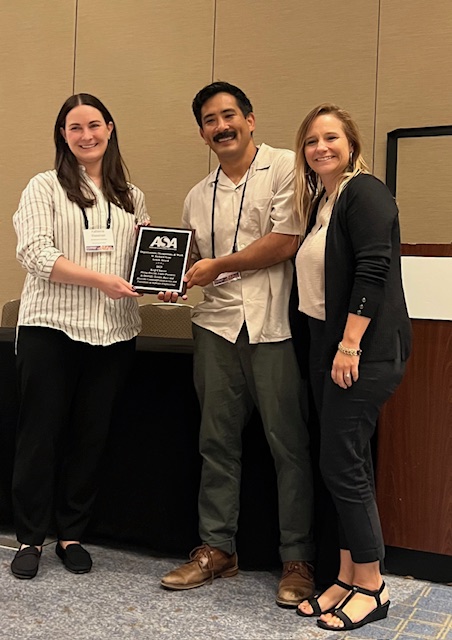
Dr. Heather A. Haveman (middle) received the Rosabeth Moss Kanter Distinguished Career Award for 2025

Dr. Katherine Sobering won the 2025 Max Weber Book Award for her book The People’s Hotel: Working for Justice in Argentina (Duke University Press, 2022).

Anna Fox (left) won the James Thompson Graduate Paper Award for her paper “Covalent Logics: Policing, Family Values, and the Reproduction of Inequality.”

Dr. Katherine Weisshaar (left), Dr. Koji Chavez (in the middle), and Dr. Tania Hutt (not in the picture) won the W. Richard Scott Article Award for their paper “Hiring Discrimination Under Pressures to Diversify: Gender, Race, and Diversity Commodification across Job Transitions in Software Engineering,” published in American Sociological Review.

Announcement: Call for Papers and Sessions for the 2026 Work and Family Researchers Network Conference

Call for Papers and Sessions for the 2026 Work and Family Researchers Network Conference

Submissions are now open for the Work and Family Researchers Network 8th Biennial Conference, June 17-20, 2026, Concordia University, Montreal, Canada. More than 400 scholars are anticipated to attend. The conference theme is Centering Care Across the Life Course

Submission deadline is October 1, 2025.
Upon request, submissions received by September 1, 2025, will be expedited to facilitate Canadian visa approval.

To submit your paper, poster, or session proposal, follow this link: https://wfrn26.mymeetingsavvy.net/

For more information on the 2026 conference and travel to Canada, visit the conference webpage: https://wfrn.org/2026-work-and-family-researchers-network-conference/

New Publication: “Home but Not Free: Rule‐breaking, Withdrawal, and Dignity in Reentry” by Gillian Slee

Slee, Gillian. 2025. “Home but Not Free: Rule-Breaking, Withdrawal, and Dignity in Reentry.” Criminologyhttps://doi.org/10.1111/1745-9125.12408

Abstract: Research on reentry has documented how material hardship, network dynamics, and carceral governance impede reintegration after prison, but existing scholarship has left underdeveloped other instances in which adverse outcomes stem from the institution’s socioemotional dynamics and people’s practical and emotional responses to bureaucratic indignities. Drawing on more than 2 years of ethnographic fieldwork with people on parole in Philadelphia, this study analyzes three sources of adversity that occur because reentry institutions’ or actors’ practices are incompatible with the behaviors and needs of system-involved people. I demonstrate how unrecognized vulnerability, discretion’s benefits and drawbacks, and risk-escalating rules contribute to adverse outcomes—withdrawal and rule-breaking—that sometimes lead to reincarceration. In failing to account for aspects of human agency and dignity, such as the ability to provide for oneself and to advance personal and familial well-being, parole guidelines often prompted withdrawal and subversion.

Gillian Slee is an Assistant Professor of Sociology at the University of Georgia. Her work focuses on understanding and ameliorating inequality in American state processes. To this end, she has studied issues and institutions with far-reaching consequences: public defense, eviction, child protective services, and parole.

Her projects ask questions such as: How do interactions and relationships shape outcomes for people involved in large government systems? What (or who) drives bureaucrats’ discretion? How does material hardship influence the exercise of rights and citizenship?

With each of her projects, Slee aims to humanize key state processes and demonstrate how institutions’ relational dynamics shape inequality. She uses a range of methods—ethnography, in-depth interviews, and statistics—and has published her work in CriminologyTheory and SocietySocial Service ReviewPolitics & Society, and Journal of Marriage and Family.

Slee completed her Ph.D. in Sociology and Social Policy at Princeton University in 2024. She earned her M.Phil. in Criminology at the University of Cambridge, where she was a Herchel Smith Harvard Scholar. Slee graduated from Harvard College with a degree in Social Studies and a minor in Psychology. She completed her postdoc at Stanford University’s Center on Democracy, Development, and the Rule of Law (CDDRL), where Slee was the Gerhard Casper Fellow in Rule of Law. Her research has been recognized with Centennial, Charlotte Elizabeth Procter, Marion J. Levy, Jr., and P.E.O. Scholar fellowships.

New Publication: “The Internal Effects of Corporate ‘Tech Ethics’: How Technology Professionals Evaluate Their Employers’ Crises of Moral Legitimacy” by Rachel Y. Kim

Kim, Rachel Y. 2025. “The Internal Effects of Corporate ‘Tech Ethics’: How Technology Professionals Evaluate Their Employers’ Crises of Moral Legitimacy.” Socio-Economic Review. https://doi.org/10.1093/ser/mwaf043

Abstract: Big Tech firms use “tech ethics” to regain public trust and influence employees’ moral evaluations of their firms and their work. Unlike traditional professions, technology professionals lack institutionalized professional ethics. Consequently, corporate “tech ethics” serve as a primary source of formal ethical guidance. Analyzing thirty-two interviews with technology professionals employed at US-based Big Tech firms, this study demonstrates that respondents’ perceptions of the effectiveness of corporate “tech ethics” closely align with how they evaluate their firms’ crises and the ethicality of their own work. Those who trusted “tech ethics” tended to believe that their companies had adequately addressed their crises and defended their work as following rigorous ethical standards, while those who were doubtful or distrusting reported greater moral unease and professional disillusionment. By highlighting the effects of organizational legitimization strategies, this study contributes to research on the role of moral perceptions in professional employees’ work experiences and career trajectories.

Rachel Y. Kim is a Ph.D. student in Sociology at Harvard University. Her research interests include economic sociology, cultural sociology, the sociology of work and professions, science and technology studies, and qualitative methods. She is particularly interested in how professionals in the tech industry, especially in Silicon Valley, navigate issues of expertise, innovation, and moral legitimacy in the context of corporate ethics.

Rachel holds a B.A. in Sociology with Honors from the University of Chicago (2019). Before graduate school, she worked as a project coordinator at Loevy & Loevy, a civil rights law firm in Chicago.

New Publication: “Reclaiming the Class Struggle in Africa Today: Four Propositions on the Revolutionary Potential of the Urban Working Class in Africa and a Marxist Critique of Factory-Workerism” by Joshua Lew McDermott

McDermott, Joshua Lew. 2025. “Reclaiming the Class Struggle in Africa Today: Four Propositions on the Revolutionary Potential of the Urban Working Class in Africa and a Marxist Critique of Factory-Workerism.” International Critical Thought 15(2). https://doi.org/10.1080/21598282.2025.2514615

Abstract: In Africa, the working class is defined less by industrial employment, stable jobs, and trade-unionism than by informal, flexible, casual, and precarious employment, by non-wage and own-account work. This is not an anomaly nor a passing phenomenon, but rather indicative of the inherent nature of capitalism. These realities do not, however, signal the end of socialist struggle nor the irrelevance of Marxism in Africa. This article challenges the trend of decentering class and capitalism in understanding so-called subaltern populations in urban Africa, while also identifying and tracing the history of, and countering what this article refers to as “factory-workerist” notions of socialism and class struggle that are dismissive of non-industrial urban workers and, by extension, the possibility of revolutionary socialism taking shape in Africa. In contrast, this work draws upon classical Marxism, especially Marx’s thoughts on the Silesian Weaver Uprising, to offer four propositions on the potential for successful socialist struggle comprised of irregular workers today, while also highlighting several cases of revolutions and social upheavals led by irregular workers in the 21st century across Africa and the world that illustrate the potential of socialist movements led by a predominately irregular working class. 

Joshua McDermott is an Assistant Professor of Sociology and Criminal Justice at Southeastern Louisiana University. He was recently awarded a Fulbright U.S. Scholar fellowship to conduct research and teach at Njala University in Bo, Sierra Leone. His research centers on irregular and informal labor in Africa, particularly how college-educated youth navigate informal economies amid structural unemployment.

While in Sierra Leone, Dr. McDermott will continue fieldwork for his first book, focusing on the political behavior and lived experiences of educated but economically marginalized individuals. His work addresses a globally relevant issue: the widespread nature of informality, which affects the livelihoods of a majority of the world’s workforce. Dr. McDermott aims to understand how informal labor impacts economic development, political stability, and community resilience.

New Book: White-Collar Blues: The Making of the Transnational Turkish Middle Class by Mustafa Yavaş

Yavaş, Mustafa. 2025. White-Collar Blues: The Making of the Transnational Turkish Middle Class. New York: Columbia University Press.

Description: White-Collar Blues follows the Turkish members of the global elite workforce as they are selected into, survive within, and opt out of coveted employment at transnational corporations. State-employed doctors, lawyers, and engineers were long seen as role models until Turkey followed the global tide of neoliberalism and began to embrace freer circulation of capital. As world-renowned corporations transformed Istanbul into a global city, Turkey’s best and brightest have increasingly sought employment at brand-name firms. Despite achieving upward mobility within and beyond Turkey, however, many Turkish professionals end up feeling disappointed, burned out, and trapped in their corporate careers. Drawing from more than one hundred interviews in Istanbul and New York City, Mustafa Yavaş develops a theory of middle-class alienation, explaining how so-called “good jobs” fail elite workers. Yavaş shows how educational investments in an increasingly competitive landscape lead to high hopes, which then clash with poor work-life balance, low intrinsic satisfaction, and a felt lack of meaning from labor in corporate workplaces. Highlighting the trade-off between freedom and financial security, White-Collar Blues reveals the hidden costs of conflating the quest for socioeconomic status with the pursuit of happiness.

Mustafa Yavaş is a sociologist studying inequality, work and occupations, immigration, social networks, and social theory. His scholarship focuses on economic and political sociology from a global perspective, motivated by longstanding questions concerning the division of labor and well-being, the dynamics of boundaries and identities, and the micro-macro problem.

Yavaş’s current research centers on neoliberal globalization, professional work, and job quality. His most recent article explains how high-paying positions at transnational corporations can leave their professional-managerial employees with a discouraging quality of working life. More broadly, his book, White-Collar Blues: The Making of the Transnational Turkish Middle Class (forthcoming from Columbia University Press in June 2025), explores the formation of a new Turkish upper-middle class and its discontents with work. 

To further his examination of transnational corporations and business professionals, Yavas is interested in exploring trends in American corporate work culture over the last century and the changing patterns of international migration since the 1970s. In a joint project with Anju Paul, he is also currently examining the rise of Dubai as a global city and its unique appeal to high-skilled workers from the Global South. Additionally, he is studying media control and democratic backsliding, focusing on the Turkish case via the landmark event of the Gezi Park Protests of 2013.

His previous research explored boundary processes in various social, economic, and political settings, including status homophily in social networksresidential segregation by incomecollective identity formation in social movements, and political polarization in social media.

Yavaş received his PhD in Sociology from Yale University and his BSc and MSc in Industrial Engineering from Boğaziçi University, and briefly worked as an engineer before pursuing his PhD. Before joining Johns Hopkins, he worked as a postdoctoral researcher and an adjunct lecturer in the Division of Social Science at NYU Abu Dhabi.

New Book: Bringing Law Home: Gender, Race, and Household Labor Rights by Katherine Eva Maich

Maich, Katherine Eva. 2025. Bringing Law Home: Gender, Race, and Household Labor Rights. Stanford, CA: Stanford University Press.

Description: The personal nature of domestic labor, and its location in the privacy of the employer’s home, means that domestic workers have long struggled for equitable and consistent labor rights. The dominant discourse regards the home as separate from work, so envisioning what its legal regulation would look like is remarkably challenging. In Bringing Law Home, Katherine Eva Maich offers a uniquely comparative and historical study of labor struggles for domestic workers in New York City and Lima, Peru. She argues that if the home is to be a place of work then it must also be captured in the legal infrastructures that regulate work. Yet, even progressive labor laws for domestic workers in each city are stifled by historically entrenched patterns of gendered racialization and labor informality. Peruvian law extends to household workers only half of the labor protections afforded to other occupations. In New York City, the law grants negligible protections and deliberately eschews language around immigration. Maich finds that coloniality is deeply embedded in contemporary relations of service, revealing important distinctions in how we understand power, domination, and inequality in the home and the workplace.

Katherine Maich is an Assistant Professor of Sociology at Texas A&M University. Her research and teaching interests include law, gender, labor informality, domestic work, ethnography, and the Global South. Her research examines dynamics of inequality in the workplace and the extent to which external factors such as law, regulation, and policy mitigate those dynamics, and with what consequences.

With funding from the Andrew Mellon Foundation, the American Association of University Women, and the Inter-American Foundation, her book, Bringing Law Home: Gender, Race, and Household Labor Rights, draws from over 24 months of ethnography in Lima, Peru and New York City, 120 in-depth interviews, and analysis of legislative transcripts. Through a Global South/North comparison, it focuses on the home as a site of paid labor and as a microcosm of social and symbolic boundaries, bringing feminist theory, race, gender, and migration into conversation with law and labor legislation.

One of her current projects (with Hilary Wething of the Economic Policy Institute) explores the effects of paid family leave on maternal mental health and time use for new mothers, and the second project (in collaboration with Oxfam America and Rural Sociology colleagues at Penn State) examines the reproduction of gender and racial inequality for migrant poultry plant and meatpacking plant workers.

She previously worked as a consultant for the International Labour Organization and the International Domestic Worker Federation by conducting fieldwork in Uruguay, Hong Kong, and South Africa on the complexities of domestic worker organizing at the international level. Drawing connections from community-based, local, and global social movements in practice provides inspiration for my own research and writing.