The Work and Family Researchers Network (WFRN) is seeking applicants for its 2026-2027 Early Career Work and Family Fellowships.
The goal of the program is to help promising young scholars establish career successes and integrate them within the WFRN research community.
Fellows receive a 2026 membership in the WFRN, conference registration, and $250 to attend an Early Career Fellowship Preconference (June 17, 2026) and the 2026 WFRN Main Conference (June 18-20, 2026) in Montreal, Canada. To be eligible, candidates must have received their doctorate in 2023 or later and have yet to progress into tenured or secure senior-level positions.
The deadline for applications is October 1, 2025.
Questions about the program can be addressed to the program co-directors, Nicole Denier (ngdenier@gmail.com) and Yang Hu (prof.yanghu@gmail.com).
Application submission information and further details on the Early Career Fellowship program can be found on this link: https://wfrn.org/early-career-fellowship/
New Publication: “Working-Class Structural Power, Associational Power, and Income Inequality” by Dr. Masoud Movahed
Movahed, Masoud. 2025. “Working-Class Structural Power, Associational Power, and Income Inequality.” Journal of Industrial Relations. Online first. https://doi.org/10.1177/00221856251326670
Abstract:
Under capitalism, workers have two sources of power: associational and structural. A vast body of social science research shows that workers’ power—often measured by union density—is associated with lower levels of income inequality. Drawing on a country-level, panel dataset for much of the post-World War II era (1960–2013), the author introduces a model of distributive outcomes that centers on the dual sources of workers’ associational and structural power. By differentiating the sources of workers’ power, the author examines the extent to which they bear on distributive outcomes across countries in the Global North. Using two-way fixed effects regression models, the author presents strong evidence that while workers’ associational and structural power are both statistically associated with lower levels of income inequality, it is workers’ structural—and not associational—power that drives egalitarian outcomes. Notably, counterfactual simulations demonstrate that, on average, structural power of the working class explains a gap up to approximately 4% in levels of income inequality over the past five decades across postindustrial countries.
Dr. Masoud Movahed’s research lies at the nexus of social stratification, economic, and political sociology. It integrates computational and quantitative methods with those of comparative historical methods in order to investigate the social-structural and institutional determinants of income and wealth inequality, both cross-nationally and within the U.S. context. More specifically, his research draws on panel data analysis, spatial econometrics, and machine learning tools, including both unsupervised clustering techniques and supervised learning algorithms. While Dr. Movahed employs computational methods, he retains a keen interest in comparative-historical methods, particularly event structure analysis (ESA), sequence analysis, and process tracing. More recently, Dr. Movahed has been part of collaborative projects that use survey experiments in U.S. contexts, alongside work in computational text analysis focusing on topic modeling and sentiment analysis.
Dr. Movahed’s papers have been published in Social Science Research, Journal of Industrial Relations, Spatial Demography, International Journal of Comparative Sociology, Journal of International Development, The Sociological Quarterly, and Interface: A Journal for and About Social Movements. Beyond academic research, Dr. Movahed also contributes essays and commentary to public-facing outlets such as Foreign Affairs, Boston Review, World Economic Forum, Harvard International Review, Yale Journal of International Affairs, and Al Jazeera.
Dr. Movahed has won awards from various sections of the American Sociological Association, including the Mathematical Sociology, Political Economy of the World-System Section, and Sociology of Development. He also received the Sabina Avdagic Early Career Scholar Prize from the Society for the Advancement of Socio-Economics (SASE). He holds an M.A. from New York University and a Ph.D. from the University of Wisconsin–Madison, followed by a postdoctoral fellowship at the University of Pennsylvania.
New Publication: “Competence over Partisanship” by Greer Mello
Greer Mellon (2025). “Competence over Partisanship: Party Affiliation Does Not Affect the Selection of School District Superintendents.” American Sociological Review 90 (4): 561–593. https://doi.org/10.1177/00031224251346993
Abstract:
In recent decades, affective polarization and partisan animosity have risen sharply in the United States. To what extent have these trends affected hiring decisions? I examine partisan biases in hiring by considering the case of school district superintendent appointments: chief executives of local U.S. elementary/secondary education systems. I analyze mixed-methods data on a decade of hiring outcomes in Florida and California from 2009 to 2019. Despite rising polarization, the data consistently show that partisan affiliation is not a primary factor in these hiring decisions. Quantitative analyses reveal no significant relationship between changes in board partisan composition and superintendent hiring outcomes within school districts. I find no relationship between board-level partisan composition and superintendent exits. Qualitative findings show hiring decisions are primarily shaped by evaluations of candidates’ interpersonal skills and competence, even among board members with strong partisan views on other policy issues. Board members discuss a strong commitment to building consensus in their selections. While I cannot rule out very small effects, these results show that school boards do not routinely prioritize applicants from their own political party. This study advances research on affective polarization and social closure by demonstrating the contingent nature of partisan affiliation on decision-making and by providing evidence of a strong respect for professionalism in a critical U.S. public sector setting.
Author:
Greer Mellon, Ph.D.
Postdoctoral Research Associate, Brown University
PSTC & Annenberg Institute for School Reform
CfA: ICOS2026
Call for Abstracts
International Conference on Organizational Sociology
ICOS 2026
Plurality, Diversity and Social Inequality in Organizations
March 16/17, 2026
University of Potsdam, Germany
Joint conference by:
- Research Committee 17 “Sociology of Organizations” of the International Sociological Association
- Section for Organizational Sociology of the German Sociological Association
- Faculty of Economics and Social Sciences, University of Potsdam
- DFG-Network “Modes of organizational diversity: theories, methodologies and practices “
- “Organization & Society” Research Group, at the Department of Sociology and Political Science, NTNU Trondheim
Submission Deadline for abstracts (600-1200 words, excl. references): November 10, 2025
Organizations are confronted with a plurality of rapidly changing challenges to which they respond in various ways. Among these challenges are the organizational governance of claims for the recognition of group identities and differences, issues of sustainability, climate action, organizational responsibility, and the challenges posed by digitalization and generative AI. These processes of rapid change do not occur simultaneously across the world; they often begin in some countries or regions and are taken up elsewhere only after several years. When organizations adapt to such newly emerging challenges, their responses may remain superficial, or organizational changes may take so long that trends and socio-political discourses in the organizational environment shift before the changes are fully implemented.
We call for papers addressing rapid and gradual, superficial and profound organizational changes, as well as organizational resistance to expectations of change, in the following three themes:
- Diversity, Equity and Inclusion in Organizations
- Sustainability Transitions, Climate Action & Organizational Responsibility
- Digitalization, Generative AI & Organizing
ICOS has a special “themed but not siloed” format – featuring multiple themes without rigid boundaries. Session hopping is encouraged!
All information can be found under www.icos2026.org
2025 ASA OOW SECTION AWARDS
Congratulations to the 2025 award recipients for their achievements!

Dr. Heather A. Haveman (middle) received the Rosabeth Moss Kanter Distinguished Career Award for 2025

Dr. Katherine Sobering won the 2025 Max Weber Book Award for her book The People’s Hotel: Working for Justice in Argentina (Duke University Press, 2022).

Anna Fox (left) won the James Thompson Graduate Paper Award for her paper “Covalent Logics: Policing, Family Values, and the Reproduction of Inequality.”
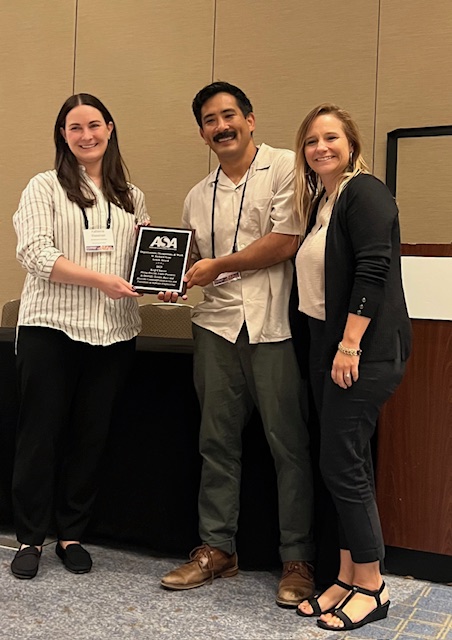
Dr. Katherine Weisshaar (left), Dr. Koji Chavez (in the middle), and Dr. Tania Hutt (not in the picture) won the W. Richard Scott Article Award for their paper “Hiring Discrimination Under Pressures to Diversify: Gender, Race, and Diversity Commodification across Job Transitions in Software Engineering,” published in American Sociological Review.
Announcement: Call for Papers and Sessions for the 2026 Work and Family Researchers Network Conference
Call for Papers and Sessions for the 2026 Work and Family Researchers Network Conference
Submissions are now open for the Work and Family Researchers Network 8th Biennial Conference, June 17-20, 2026, Concordia University, Montreal, Canada. More than 400 scholars are anticipated to attend. The conference theme is Centering Care Across the Life Course.
Submission deadline is October 1, 2025.
Upon request, submissions received by September 1, 2025, will be expedited to facilitate Canadian visa approval.
To submit your paper, poster, or session proposal, follow this link: https://wfrn26.mymeetingsavvy.net/.
For more information on the 2026 conference and travel to Canada, visit the conference webpage: https://wfrn.org/2026-work-and-family-researchers-network-conference/
New Publication: “Home but Not Free: Rule‐breaking, Withdrawal, and Dignity in Reentry” by Gillian Slee
Slee, Gillian. 2025. “Home but Not Free: Rule-Breaking, Withdrawal, and Dignity in Reentry.” Criminology. https://doi.org/10.1111/1745-9125.12408
Abstract: Research on reentry has documented how material hardship, network dynamics, and carceral governance impede reintegration after prison, but existing scholarship has left underdeveloped other instances in which adverse outcomes stem from the institution’s socioemotional dynamics and people’s practical and emotional responses to bureaucratic indignities. Drawing on more than 2 years of ethnographic fieldwork with people on parole in Philadelphia, this study analyzes three sources of adversity that occur because reentry institutions’ or actors’ practices are incompatible with the behaviors and needs of system-involved people. I demonstrate how unrecognized vulnerability, discretion’s benefits and drawbacks, and risk-escalating rules contribute to adverse outcomes—withdrawal and rule-breaking—that sometimes lead to reincarceration. In failing to account for aspects of human agency and dignity, such as the ability to provide for oneself and to advance personal and familial well-being, parole guidelines often prompted withdrawal and subversion.
Gillian Slee is an Assistant Professor of Sociology at the University of Georgia. Her work focuses on understanding and ameliorating inequality in American state processes. To this end, she has studied issues and institutions with far-reaching consequences: public defense, eviction, child protective services, and parole.
Her projects ask questions such as: How do interactions and relationships shape outcomes for people involved in large government systems? What (or who) drives bureaucrats’ discretion? How does material hardship influence the exercise of rights and citizenship?
With each of her projects, Slee aims to humanize key state processes and demonstrate how institutions’ relational dynamics shape inequality. She uses a range of methods—ethnography, in-depth interviews, and statistics—and has published her work in Criminology, Theory and Society, Social Service Review, Politics & Society, and Journal of Marriage and Family.
Slee completed her Ph.D. in Sociology and Social Policy at Princeton University in 2024. She earned her M.Phil. in Criminology at the University of Cambridge, where she was a Herchel Smith Harvard Scholar. Slee graduated from Harvard College with a degree in Social Studies and a minor in Psychology. She completed her postdoc at Stanford University’s Center on Democracy, Development, and the Rule of Law (CDDRL), where Slee was the Gerhard Casper Fellow in Rule of Law. Her research has been recognized with Centennial, Charlotte Elizabeth Procter, Marion J. Levy, Jr., and P.E.O. Scholar fellowships.
Graduate Opportunity: Join OOW as Co-Blog Admin!
OOW is recruiting a new graduate co-blog admin for the OOW website! Responsibilities include checking email every week, publishing posts on the website, and also replying to emails about successful posts. You will be working with the OOW Treasurer and Secretary, Dr. Jill Yavorsky. Please send Dr. Yavorsky an email (jyavorsk@charlotte.edu) if interested.
New Publication: Toward New Organizational Sociology of Quantification

Subscribe to continue reading
Subscribe to get access to the rest of this post and other subscriber-only content.
New Publication: “The Internal Effects of Corporate ‘Tech Ethics’: How Technology Professionals Evaluate Their Employers’ Crises of Moral Legitimacy” by Rachel Y. Kim
Kim, Rachel Y. 2025. “The Internal Effects of Corporate ‘Tech Ethics’: How Technology Professionals Evaluate Their Employers’ Crises of Moral Legitimacy.” Socio-Economic Review. https://doi.org/10.1093/ser/mwaf043
Abstract: Big Tech firms use “tech ethics” to regain public trust and influence employees’ moral evaluations of their firms and their work. Unlike traditional professions, technology professionals lack institutionalized professional ethics. Consequently, corporate “tech ethics” serve as a primary source of formal ethical guidance. Analyzing thirty-two interviews with technology professionals employed at US-based Big Tech firms, this study demonstrates that respondents’ perceptions of the effectiveness of corporate “tech ethics” closely align with how they evaluate their firms’ crises and the ethicality of their own work. Those who trusted “tech ethics” tended to believe that their companies had adequately addressed their crises and defended their work as following rigorous ethical standards, while those who were doubtful or distrusting reported greater moral unease and professional disillusionment. By highlighting the effects of organizational legitimization strategies, this study contributes to research on the role of moral perceptions in professional employees’ work experiences and career trajectories.
Rachel Y. Kim is a Ph.D. student in Sociology at Harvard University. Her research interests include economic sociology, cultural sociology, the sociology of work and professions, science and technology studies, and qualitative methods. She is particularly interested in how professionals in the tech industry, especially in Silicon Valley, navigate issues of expertise, innovation, and moral legitimacy in the context of corporate ethics.
Rachel holds a B.A. in Sociology with Honors from the University of Chicago (2019). Before graduate school, she worked as a project coordinator at Loevy & Loevy, a civil rights law firm in Chicago.
 Organizations, Occupations and Work