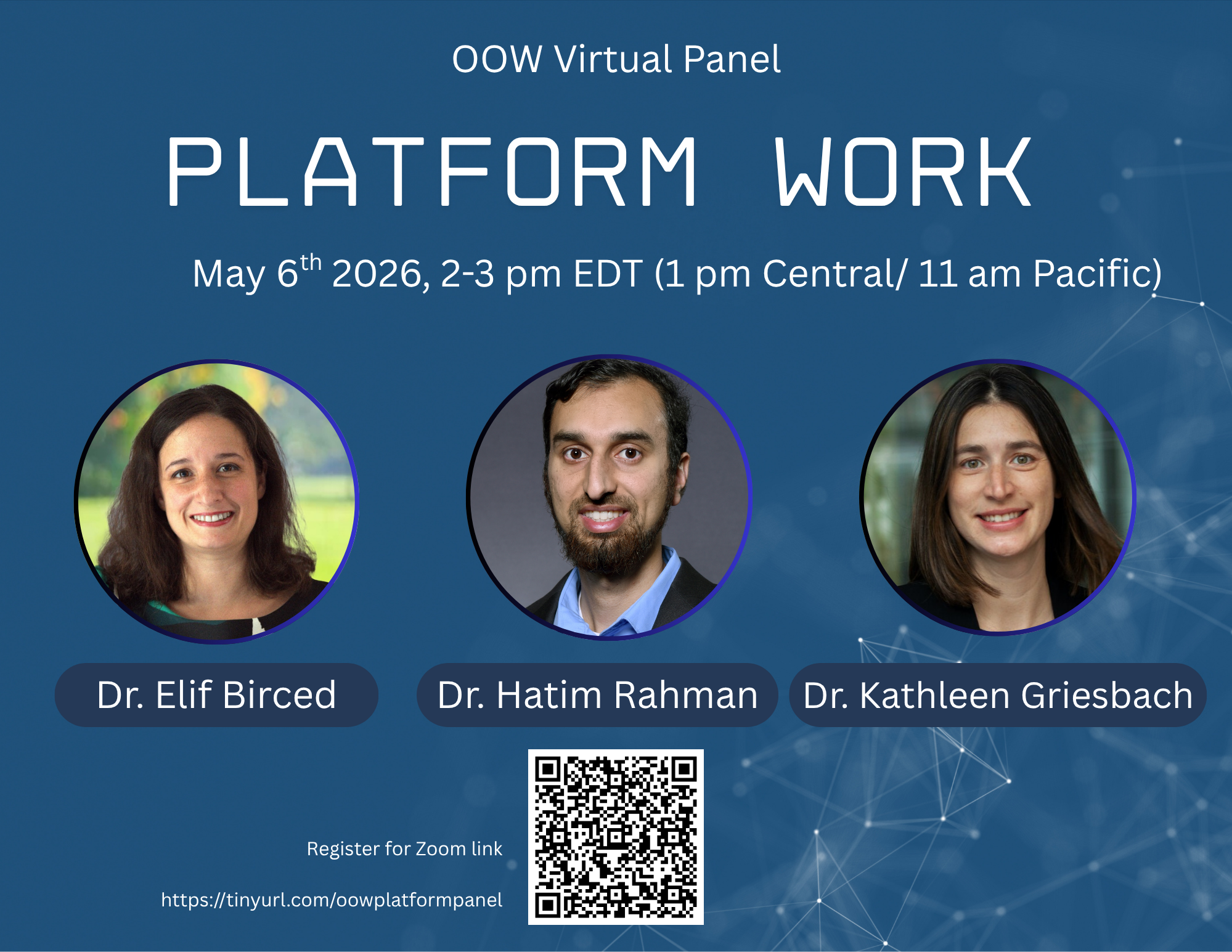
OOW Virtual Panel on Platform Work

May 6th, 2-3 pm EDT (11am-noon PDT/ 7-8pm BDT)

We invite you to join our virtual panel on digital platform work featuring:

Dr. Elif Birced, Dr. Hatim Rahman, and Dr. Kathleen Griesbach.

Work on digital platforms has exploded in the past decade and continues to evolve with technology. Today, these platforms cover an ever-increasing range of jobs. This panel brings together research on various types of platform work, including content creation, professional services, and ride-hailing and delivery.  

Register for the Zoom link herehttps://tinyurl.com/oowplatformpanel

Presenter Bios:

Elif Birced is a Postdoctoral Associate at MIT Sloan School of Management and Schwarzman College of Computing. Broady, her research is at the intersection of sociology of work, cultural production and social media. Specifically, she studies how technology is reshaping work, worker commitment, and control over work with a particular focus on social media platforms. She will be an Assistant Professor of Sociology at Villanova University, starting in Fall 2026. 

Hatim A. Rahman is an Associate Professor of Management and Organizations and Sociology (by courtesy) at Northwestern University. His research investigates how artificial intelligence is impacting the nature of work and employment relationships in organizations and labor markets. His award-winning book, Inside the Invisible Cage: How Algorithms Control Workers (University of California Press), investigates how digital labor platform organizations use algorithms to control workers’ job opportunities. 

Kathleen Griesbach is an Assistant Professor of Sociology at the University of Texas at Austin. She is broadly interested in work and inequality, the significance of time and space for social experience, and the dynamic interplay between culture and economic life. Much of her research examines how temporal and spatial instability shape workers’ experiences, and how workers in turn pursue dignity, meaning, and a path forward amid economic instability. She received her PhD in Sociology from Columbia University and was previously a postdoctoral researcher at the Max Planck Institute for the Study of Societies in Cologne.
New Publication: “The Ghost of Middle Management: Automation, Control, and Heterarchy in the Platform Firm” by Janet A. Vertesi & Diana Enriquez 

Vertesi, Janet A., and Diana Enriquez. 2025. “The Ghost of Middle Management: Automation, Control, and Heterarchy in the Platform Firm.” Sociologica 19(1):13–35. https://doi.org/10.6092/issn.1971-8853/16415.

Abstract: In an effort to attend to the distinct organizational form of algorithmic management, we interrogate the arrangement of platform labor through the lens of the post-bureaucratic organization instead of that of the industrialized factory. Prior studies of gig workers rely heavily on sociological accounts of factory labor, but we posit that gig economy platforms represent a heterarchical organizational form, marrying the logics of industrial control induced by computational systems with the logics of post-bureaucracy inherited from flattening firms and downsizing middle management. In a technique we describe as automation by omission, we show how middle-managerial roles and responsibilities are excised entirely from the platform firm, how the vestigial traces of such roles are only imperfectly replaced by technical systems, and how “situated” managerial tasks essential to post-bureaucratic organizations are picked up by the worker, uncompensated. This heterarchical arrangement benefits the firm in multiple ways, while its competing structural conditions of labor leave workers to navigate multiple valuation systems at once. Appreciating gig work’s embedded post-bureaucracy shifts our understanding of common worker experiences such as peer-to-peer organizing and just-in-time scheduling illuminates dissonant accounts of empowerment and algorithmic despotism, and exposes new avenues for worker disenfranchisement.

Janet A. Vertesi Department of Sociology, Princeton University
Janet A. Vertesi is Associate Professor of Sociology and Associate Director of the Keller Center for Innovation in Engineering Education at Princeton University (USA). A sociologist of science, technology, and organizations, her ethnographies of NASA missions include Shaping Science (Chicago University Press, 2015) and Seeing Like a Rover (Chicago University Press, 2020), and she is a leader in the digitalSTS (Princeton University Press, 2014) community.

Diana Enriquez  Department of Sociology, Princeton University
Diana Enriquez completed her PhD in Sociology at Princeton University (USA). Her dissertation research focused on high-skill freelancers as a subset of the alternative workforce facing new challenges before and during COVID-19. Other research projects examine the role of platforms in managing gig workers and automation in the workplace. Her research interests include economic sociology, labor, law, and technology.

Call for Papers: Journal of Sociology special issue on inequalities in the gig economy

Special edition of the Journal of Sociology 2019 on inequalities in the gig economy era: gender and generation challenges edited by Brendan Churchill, Signe Ravn and Lyn Craig, University of Melbourne. The special edition will focus on the intersecting implications for gender and generational inequalities in the ‘gig economy’ era, a term which we use to describe the contemporary labour market characterised by precarious employment and new (digital) forms of job seeking and entrepreneurship that expose workers to greater financial risks, social insecurities and inequalities. It will also consider the gendered dimensions of educational participation outcomes in the light of these changed labour market conditions. Deadline for submission of a 300-word abstract for consideration: 8 April 2018. More details: http://arts.unimelb.edu.au/e/gig-economy