Message from the Chair / Virtual Event: Recording of Broadening our Approaches to Studying Race and Racism in OOW

Dear OOW community,

We had a wonderful, thought provoking, event revolving around broadening the conversation about race in research on OOW, with Victor Ray (University of Iowa U.S.A) interviewing Stella Nkomo (The University of Pretoria in South Africa) and Bobby Banerjee (Cass Business School, UK) on the foundational nature of race in organizations, and a paper presentation panel, with cutting-edge research from LaTonya Trotter (on Racialized Exclusion in the Health Care Profession), James Jones (on Racism in the Halls of Power) and Oneya Okuwobi (on The Hidden Costs of Diversity Initiatives). 

Here is the link to the recording: https://youtu.be/BMzfKr9z0aA

Thank you!

Alexandra

Call for Submissions: Symposium on Corruption, the Rise of Populism, and the Future of Democracy  

CALL FOR SUBMISSIONS 
Symposium on Corruption, the Rise of Populism, and the Future of Democracy 
The University of Iowa 
April 1-2, 2022 

SUBMISSION DEADLINE: May 15, 2021 

We invite submissions from graduate students who are interested in presenting their research at a two-day symposium on corruption and the rise of populism, organized by the International Programs and the Department of Political Science at the University of Iowa. 

This event will convene a number of senior and early-career scholars from across the United States and Canada in an effort to foster an open dialogue about the challenges that corruption and populism pose to good governance and democracy globally. 

Graduate student invitees will benefit from participating in the panels, networking, and attending a workshop dedicated specifically to the graduate-level study of corruption. It is also our hope that this event will lead to a collaborative publication following the meeting in Iowa. 

Please note that we are specifically looking for submissions that address the following topics in East/South East Asia, East Central Europe, North America, and Latin America. 

  • Corruption and democratic consolidation, stability, and erosion 
  • Corruption, informal networks, and civil society 
  • Corruption, patronage, and electoral processes 
  • Corruption, misinformation, and the spread of extremist ideologies 
  • Corruption, anti-corruptionism, and human rights abuses 

The University of Iowa will cover the transportation and accommodation costs for the graduate students who are selected to participate in the symposium. 

SUBMISSION GUIDELINES

Please send an extended abstract of the paper you intend to write (approximately 500 words) and your CV to Marina Zaloznaya at marina-zaloznaya@uiowa.edu by May 15, 2021. Selected participants will be notified by June 15, 2021. The deadline for submitting full papers is March 1, 2022. 

OOW Members Receive the International Institute’s Best Book Award

International Institute’s Best Book Award for 2021 goes to Thomas Janoski and Darina Lepadatu 

The Cambridge International Handbook of Lean Production by Thomas Janoski and Darina Lepadatu is the culmination of almost 20 years of work, an NSF grant, and the author’s fourth book on lean production in organizational and industrial Sociology.  Darina Lepadatu said that: 

“It was close to a miracle that we have accomplished this project working with 40 authors from all over the world in the middle of the worst pandemic of the century. The co-editor’s collaborators were on lockdowns, got divorces, received cancer diagnoses, retired or moved to other countries, but they still worked with us until it was finished.” 

The Handbook recently won “The 2021 ILSSI Best Book Award” presented by John Dennis and Constantin Stan of the International Lean Six Sigma Institute in Cambridge, UK. They said the book “will help new generations to develop a greater understanding of the power and importance of lean principles and techniques.” The award committee also commented on the quality of the chapter authors including James Womack and Daniel Jones of early bestseller The Machine that Changed the World fame. We will make a presentation on May 20th to the Institute and its members in a webinar.

The International Handbook has three parts. Part I is unique in that it presents the very diverse theoretical viewpoints on lean production from five disciplines: management, industrial engineering, industrial relations, the social sciences, and labor process theory. As we indicate in the social science chapter, sociology is split between conventional work on the sociology of work who have a negative view toward lean production, and specialists in the areas of Toyotism and Japan who have a more positive view. Surprising to sociologists is that industrial engineering is the discipline most involved with lean production. In many ways “lean production” is an unfortunate description of this division of labor, and Toyotism is the better term. Part II is about lean production across industries: automobiles, product innovation, telecommunications, healthcare, public services, mass merchandizing, finance, and software. Part II also incudes an essay from the practitioner approach in industrial engineering with the True Lean Toyota Production System approach.  Part III is about the implementation of lean in different countries: Korea, the US, UK, Germany, France, China, India, Australia, Mexico and Russia. There are major differences with successes and failures in these countries with very different cultures, capitalisms, and labor relations. Part III starts out with an analysis of survey data showing that lean production has become the dominant form of the division of labor in Europe and the United States. There are many unsuspected surprises: the encounter of lean and the Chinese Communist Party; Toyota’s difficulties in India, and Russian worker suspicions and resistance. Based on massive surveys in the West, Toyotism is three times more frequent than Taylorist methods, but a close relative called ‘learning methods’ (i.e., socio-technical theory) also has a large presence. 

The larger purpose of the International Handbook and the authors’ recent book Framing and Managing Lean Organizations (Routledge, 2020) is to bring lean production and Toyotism to sociology as the dominant division of labor in the capitalist production system. We emphasize many of the positive aspects of lean production including participation in teamwork and higher product quality, but also the negative aspects like temporary employment, outsourcing, and offshoring. In our three chapters in the handbook and previous books, we emphasize that there are three forms of lean production: Toyotism as the fullest form of lean production; Nikeification with its split between Toyotist innovation and Fordist production (e.g., Apple in the US versus Apple subcontractors in China); and Waltonism (from Matt Vidal) with Walmart’s use of only just-in-time inventory and little attention paid to worker participation. More broadly, we point out that Toyotism — like Fordism before it with unionism, Keynesianism, and the welfare state — also has political implications that often converge with neoliberalism, anti-unionism and some high-tech tax avoidance. But Thomas Janoski, who was a piston-shooter on an automotive engine line in the late 1960s, said: 

“The involvement of workers in quality control, design processes, and job rotation gives many workers a sense of respect and participation that they did not have under Fordism. Also, consumers no longer have to fear the dreaded “lemon” that would haunt their driving for years.”
Call for Papers: Mini Conference and Special Issue of Work and Occupations

Call for Papers 
Precarious Employment and Well-Being during the COVID-19 Pandemic 
A Mini Conference and Special Issue 
Work and Occupations 

This call invites papers for a mini conference and subsequent special issue of Work and Occupations dedicated to precarious employment and well-being during the COVID-19 pandemic. Prospective contributors should submit a full paper as a single document to the conference organizers by November 15, 2021. We encourage submissions from scholars of different demographic backgrounds, nationalities, career stages, theoretical frames, and methodological orientations. All submissions must be original work that has not been previously published in part or in full. The conference organizers and special issue guest editors are Quan Mai (Rutgers University), Lijun Song (Vanderbilt University), and Rachel Donnelly (Vanderbilt University). 

The authors of accepted papers will be invited to a virtual one-day mini conference where they will present their paper and receive feedback from conference organizers and other invited participants. The mini conference is scheduled to take place on Friday, January 21, 2022. Based on the conference organizers’ recommendations, discussions at the conference, and the fit with the special issue, the guest editors will invite a subset of authors to submit their papers to Work and Occupations with the expectation that their manuscripts will be published in the special issue if they pass the external peer-review process. The authors will be notified of editorial evaluations in September 2022. Last round revisions are due in early November 2022.

* * * 

In recent decades, a wave of structural changes contributes to the troubling rise of precarious employment in both the developed and developing worlds. The adverse effects of precarious work extend beyond workers’ employment-related dimensions such as pay, benefits, and job satisfaction. Emerging scholarship on this topic documents how this mode of employment generates significant negative consequences for various aspects of workers’ lives, including their physical and mental health, prospects for social mobility, family life, and socioeconomic well-being more generally. 

Since late 2019, the COVID-19 pandemic has been wreaking havoc on billions of workers’ employment experiences across the globe and damaging their well-being and livelihoods. The impact of the pandemic is particularly profound among precariously employed workers in nonstandard employment arrangements, especially at a time when many countries have spent decades rolling back social safety nets. Precarious workers in healthcare, nursing homes, grocery and retail stores, transportation, and delivery have been unable to work remotely and had to interact closely with customers and patients often without sufficient safety measures. Workers in restaurants, bars, and movie theaters have been laid off and faced a reduction in benefits, adding great uncertainty to their already precarious working conditions. Many self-employed workers, independent contractors, gig-workers, and freelancers have been facing unemployment without being laid off as their contracts go unrenewed. With limited access to collective bargaining power and adequate protective measures, precarious workers have been exposed to higher risks of unfair treatment and exploitation. The pandemic also put workers in otherwise “good” jobs in precarious situations. Millions of high-skilled and high-paid workers in full-time positions have experienced precarity after being temporarily furloughed or forced to work on reduced hours, often for an unspecified amount of time. 

The special issue aims to bring together cutting-edge studies from diverse disciplinary backgrounds on precarious work and well-being during the pandemic. The topics of interest include, but are not limited to:

  • the influence of employment precarity on workers’ risk of exposure to and infection with COVID-19; 
  • the influence of employment precarity on workers’ mental, physical, and socioeconomic well-being; 
  • changes in employment precarity during the pandemic and subsequent short- and long-term consequences for well-being; 
  • the influence of employment precarity on workers’ healthcare accessibility and utilization; 
  • individual and family adaptations to the risks of unemployment and illness; 
  • the influence of employment precarity and risk of illness on social relationships between co-workers and between front-line workers and customers/patients; 
  • public policy adaptations to mitigate the risks of unemployment, precarious employment, and illness; 
  • employer and labor union interventions to mitigate the risks of unemployment and illness; and 
  • social disparities (e.g., race/ethnicity, gender, sexuality, and class) and global variations in all the above themes. 

Prospective contributors are welcome to consult with any of the conference organizers and guest editors about the potential fit of their projects. To submit your paper, please email it to wox_workwellbeing2021@sociology.rutgers.edu by November 15, 2021. 

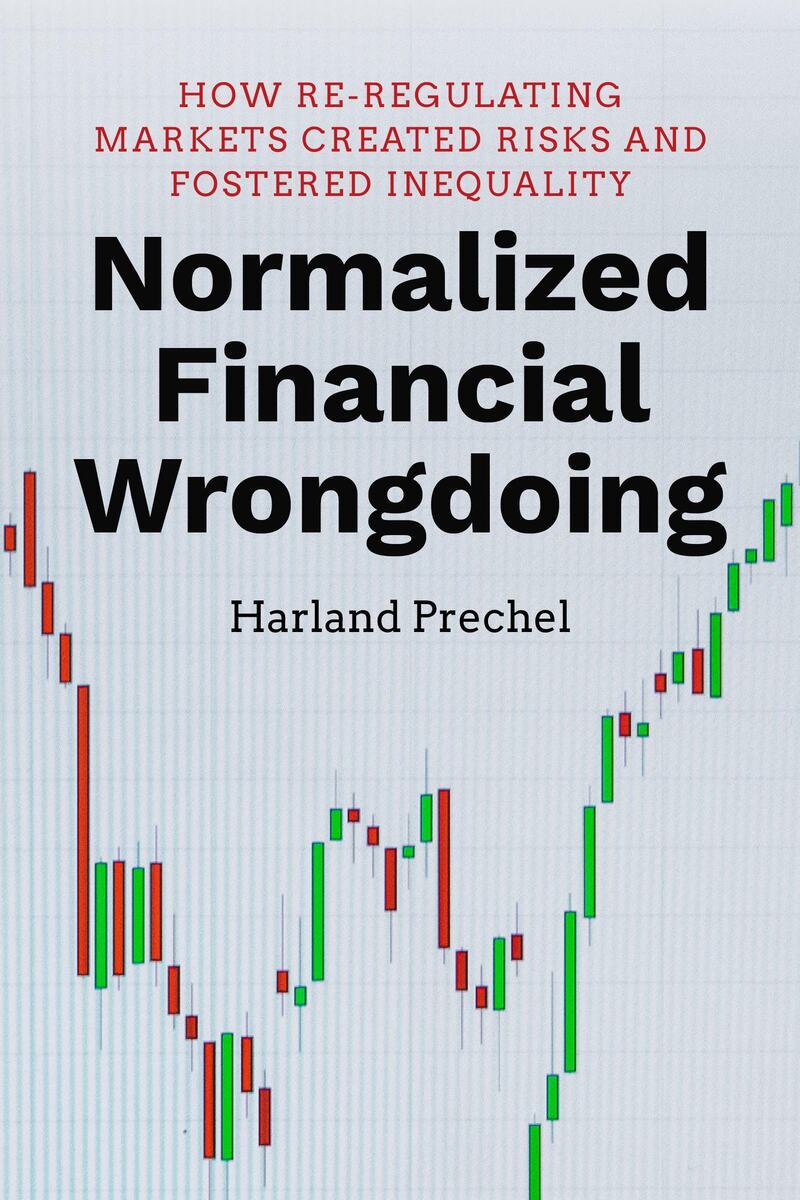
Member Publication: Normalized Financial Wrongdoing

Please check out the recent publication by OOW member Harland Prechel:

Prechel, Harland. 2020. Normalized Financial Wrongdoing: How Re-Regulating Markets Created Risks and Fostered Inequality. Stanford: Stanford University Press.

Here is a short description of the book:

In Normalized Financial Wrongdoing, Harland Prechel examines how social structural arrangements that extended corporate property rights and increased managerial control opened the door for misconduct that contributed to the 2008 financial crisis and historically high levels of inequality. Beginning his analysis with the financialization of the home-mortgage market in the 1930s, Prechel shows how pervasive these arrangements had become by the end of the century, when the banks created political coalition with other economic sectors and developed strategies to participate in financial markets. The book examines political and legal landscapes in which corporations are embedded to answer two questions: First, how did banks and financial firms transition from being providers of capital to financial market actors in their own right? Second, how did new organizational structures cause market participants to engage in high-risk activities?

You can find more about the book and buy it on the Stanford University Press website.

Message from the Chair: Three exciting OOW and ASA events coming up – April 15th, 20th, 21th

Dear OOWs,

Three exciting virtual events are coming up – April 15th, 20th, 21st: 

I. OOW Virtual Discussion and Panel: “Broadening our Approaches to Studying Race and Racism in OOW” on April 21, 1:30-4:00pm.

Victor Ray (University of Iowa U.S.A) will interview Stella Nkomo (The University of Pretoria in South Africa) and Bobby Banerjee (Cass Business School, UK) on the foundational nature of race in organizations.

This will be followed by a paper presentation panel, in which we will hear about cutting-edge research from LaTonya Trotter (on Racialized Exclusion in the Health Care Profession), James Jones (on Racism in the Halls of Power) and Oneya Okuwobi (on The Hidden Costs of Diversity Initiatives). 

Click here for more information and registration link.

II. ASA Virtual Pro-Seminar: Publishing in Peer-Reviewed Journals 

Thursday, April 15 3:00 p.m. Eastern/ 12:00 p.m. Pacific 

Guest: Kristen Barber (Southern Illinois University Carbondale) 

You have a paper that you think is publishable, but how do you choose a journal? What can you expect from the peer review process? What is an impact factor? Join us for an overview of publishing in peer-reviewed journals by Kristen Barber, who will draw on her experience as a journal editor, peer reviewer, and article author. Bring your questions about any aspect of the article-publishing process. Closed captions available; this event will not be recorded. Members can register for free here.  

III. Webinar on Thriving Outside Academia: Advice from Sociologists in Practice Settings 

Tuesday, April 20 1:00 p.m. Eastern/10:00 a.m. Pacific 

Panelists:  

o   Chloe E. Bird (senior sociologist, RAND) 

o   Howard Caro-López (civil rights research analyst, U.S. Federal Government) 

o   Jillian Powers (responsible AI lead, Cognizant) 

o   Curtis L. Webb III (senior researcher and consultant, Design Impact) 

 Many sociologists choose careers outside the academy: in government, nonprofit organizations, commercial industry, research centers, and other practice settings. This webinar brings together four sociologists working in diverse fields who will provide insights into these careers and share advice on preparing for these types of jobs. Current graduate students, faculty advisors, and sociology PhDs at any career stage are encouraged to attend. Closed captions available. Members can register for free here

Job Posting: Lecturer at Loughborough University London

This is a message from Matt Vidal:

“We are hiring a new lecturer in the Institute for International Management, Loughborough University London. Lectureships in the UK are equivalent to Assistant Prof positions in the US. It’s a permanent position (the UK does not have tenure review.)

https://www.lboro.ac.uk/join-us/outstanding/london/

Our Institute has a heavy emphasis on comparative political economy and critical management approaches (broadly defined). We are keen to get applications from sociologists. We are committed to increasing diversity and strongly encourage applications from underrepresented groups.

https://www.lborolondon.ac.uk/institutes/institute-for-international-management/our-staff/

Member Publication: Wealth

Please check out the recent publication by OOW member Yuval Elmelech:

Elmelech, Yuval. 2021. Wealth. Cambridge: Polity.

Here is a short description of the book:

The pursuit of wealth has captivated people’s attention for centuries. Yet, as a topic of social research, the way in which wealth is accumulated and unequally distributed has largely been neglected, remaining hidden beneath data on income inequality. Wealth aims to address this blind spot in the academic discourse.

In accessible prose, Yuval Elmelech explains how personal wealth differs fundamentally from other conventional measures of socioeconomic status and why it has become increasingly important to our understanding of social mobility and stratification. Crucially, Elmelech presents a dynamic sociological framework of wealth attainment that illuminates the effects of cumulative advantages and disadvantages over the course of an individual’s life, and across generations. He describes how these advantages and disadvantages are in turn shaped by a complex interplay of multiple markets, changing demographic landscapes, and persistent inter-group wealth disparities.

Blending theoretical approaches with empirical evidence and macro-level contexts with micro-level processes, this book is an astute guide for thinking about wealth as a key determinant of social and economic wellbeing and for interrogating the role of wealth accumulation in social inequality.

For 20% off the paperback version, go to www.politybooks.com and use code EL731 at checkout (valid from 3/30/2021 until 7/31/2021).

OOW Virtual Event: Broadening our Approaches to Studying Race and Racism in OOW

Dear OOW Members,

Please join us for an important and exciting virtual event, “Broadening our Approaches to Studying Race and Racism in OOW” on April 21, 1:30-4:00pm.

We will begin with a panel discussion, where Victor Ray (University of Iowa U.S.A.) will interview Stella Nkomo (The University of Pretoria in South Africa) and Bobby Banerjee (Cass Business School, UK) on the foundational nature of race in organizations.

This will be followed by a paper presentation panel, in which we will hear about cutting-edge research from LaTonya Trotter (on Racialized Exclusion in the Health Care Profession), James Jones (on Racism in the Halls of Power) and Oneya Okuwobi (on The Hidden Costs of Diversity Initiatives). 

Click here for more information and registration link.

See you there!

The OOW event committee

Member Publication: Choosing Bad Jobs: The Use of Nonstandard Work as a Commitment Device

Please check out the recent publication by OOW member Laura Adler:

Adler, Laura. 2020. “Choosing Bad Jobs: The Use of Nonstandard Work as a Commitment Device.” Work and Occupations, Online First.

Abstract

With nonstandard work on the rise, workers are increasingly forced into bad jobs—jobs that are low-paying, part-time, short-term, and dead-end. But some people, especially in cultural industries, embrace this kind of work. To understand why some might choose bad jobs when better options are available, this paper examines the job preferences of aspiring artists, who often rely on bad day jobs as they attempt to achieve economic success in the arts. Using interviews with 68 college-educated artists, I find that their preferences are informed not only by utility and identity considerations—two factors established in the literature—but also by the value of bad jobs as commitment devices, which reinforce dedication to career aspirations. The case offers new insights into the connection between jobs and careers and enriches the concept of the commitment device with a sociological perspective, showing that these devices are not one-time contracts but ongoing practices.