Paper Development Workshop on the Experience of Illegality | University of St. Gallen, Switzerland | Apr 1–2, 2026 | Abstracts Due Dec 15, 2025

PAPER DEVELOPMENT WORKSHOP (PDW)

The Experience of Illegality
Bodies, identities, moralities

April 1 & 2, 2026, Institute of Sociology, University of St.Gallen, Switzerland

Organizing committee
Loïc Pignolo, University of St.Gallen, Switzerland.
Guillaume Dumont, Ethnographic Institute, Emlyon Business School, France.

Abstract submission
Please send an abstract of 300 words and a short biographical note to gdumont@em-lyon.com and loic.pignolo@unisg.ch by December 15, 2025. Notification of acceptance will be sent by January 15, 2026. Papers must be submitted by March 15, 2026.

There is no registration fee, and we will cover the lunch on both days and the dinner on the first day. Additionally, partial grants for travel and accommodation can be provided to a small number of participants with limited resources. Please indicate if you require financial support.

Participation in the workshop is open to all upon registration.
For any additional details please visit: https://www.guillaumedumont.eu/illegality-pdw

Purpose and format
This PDW aims to provide guidance to researchers from various disciplines (e.g., sociology, anthropology, criminology, and organizational studies) at different stages of their careers, offering support in developing their papers. Invited discussants will help participants consider novel ways to utilize their data to craft a compelling narrative and to create a theoretical contribution based on these data in a collegial manner. The PDW will be structured as a two-day interactive workshop. Each author will be given 10 minutes to present the paper and 35 minutes for discussion. Two discussants will review each paper and provide developmental feedback to strengthen and improve the authors’ work. Furthermore, all authors must also commit to reading two selected papers before the workshop to provide additional feedback. 

We do not expect the papers to be polished and well-finished. Still, they should be sufficiently advanced to be reviewed by the discussants, build upon a strong empirical foundation, and demonstrate the potential to contribute to developing a broader understanding of the experience of illegality. Given the workshop’s aim, published papers will not be accepted.

Theme
Popular perceptions of illegality often stem from sensationalist portrayals in the media, movies, or TV shows. These accounts depict, at times, dangerous criminals, mafia-like and cartel organizations, and crime-ridden neighborhoods where simply visiting could lead to one’s demise. Likewise, they associate illegality with individuals who strive to stay under the radar, bending the rules for their own personal gain, disregarding laws, moral norms, or ethical considerations for themselves or others. Such accounts render illegality inherent to specific practices, activities, and individuals through their naturalization, for instance, due to personal traits, lifestyles, life trajectories, or the characteristics of a particular area. 

The ethnography of the daily experience of illegality, however, offers a very different picture, one that foregrounds the socio-cultural, as well as economic and political construction of illegality (Flores and Schachter 2018) and its multi-layered consequences for those subjected to these regimes. As migration studies demonstrated, illegality is “a form of juridical status, a sociopolitical condition, and a way of being-in-the-world” (Willen 2019:47). Illegality, in that sense, not only shapes the social world of individuals subjected to illegalization processes (e.g. Sigona 2012) but also has a profound impact on their inward parts. It is an eminently embodied, temporal, and subjective experience (Garza 2018; Gutiérrez-Cueli et al. 2024)—a construct that must be analyzed rather than reified or naturalized.

This call for papers takes as its structuring theme how illegality is experienced by people in the daily conduct of their lives. Specifically, we invite papers that focus on the intricacies between illegality and the bodies, identities, and moralities of those involved in illegal activities across illegal or legal markets. Methodologically, then, we expect contributors to employ ethnographic or, more broadly, qualitative research methods. This combination, we believe, is uniquely positioned to reveal the penetration of illegality in many aspects of the lives of workers, clients, consumers, or managers are subjected to it in ways that are most often invisible to external outsiders. We also expect these accounts of micro-level field dynamics to connect with broader, structural trends, as illegality, despite being experienced subjectively, is a socio-cultural, economic, and political construction with concrete implications. We further structure our inquiry into the experience of illegality around three main areas—bodies, identities, and moralities—to be explored either in relation to one another or independently, as well as across contexts: 

Bodies: We are interested in the embodiment of illegalization. Illegality, indeed, is not a mere label applied to people and, thus, external to them. Instead, it is profoundly embodied and enacted (Holmes 2023), as well as reacted to (Gonzales and Chavez 2012). Resultingly, we expect papers that address how illegality and illegalization shape the body, for instance, through imposing circumstances for life and work on people. Likewise, we are also interested in papers examining how the body can be played out and potentially instrumentalized due to this imposed condition, for instance, through specific bodily practices that derive from the illegalization or aim to avoid detection (Perrin 2018). Overall, we welcome proposals that address the embodiment of illegality in its various forms.

Identities: In a context where the legal is usually viewed as legitimate, illegality and illegalization carry consequences for individual and collective identities. Accordingly, we are interested in papers looking at questions such as how illegalization impacts self-representation across different spheres of life (e.g., work, leisure), how individuals gain respect and establish themselves through alternative means when navigating circumstances of illegality (Erickson, Hochstetler, and Copes 2019; Estrada and Hondagneu-Sotelo 2011), which coping mechanisms they develop to address illegalization, how the association of illegality with specific groups shapes the construction of collective identities, and how illegality nurture specific uncertain future that are imagined and enacted through these identities. 

Moralities: Illegality and illegalization are typically motivated and justified based on broader moral principles (Fassin 2012), over which governmental institutions have a monopoly and the power to enforce (Weber 1946). Given the multiplicity of moral orders (Boltanski and Thévenot 1991), we invite papers that examine how individuals and groups navigate the existence of multiple, coexisting moralities that may conflict due to illegality. We also expect papers examining how people contest the imposition of a broader moral order (Hübschle 2017; Paul Mmahi and Usman 2020), as well as how they negotiate among different moralities and express their discontent, for instance, through the emergence of advocacy groups contesting the banning of activities or reclaiming social justice (De Rond, 2025).

For any additional details please visit: https://www.guillaumedumont.eu/illegality-pdw
Announcement: Summer 2025 Gender, Professions, and Organizations Writing Workshop at ASA Annual Meeting

Summer 2025 Gender, Professions, and Organizations Writing Workshop at ASA Annual Meeting

Register for the semi-annual Gender, Professions, and Organizations Writing Workshop at the ASA Annual Meeting on Friday, August 8. Spots are limited; sign up here.

The semi-annual Gender, Professions, and Organizations Writing Workshop is back this summer from 9 am to 5 pm on Friday, August 8, 2025 – the day of pre-conference activities for the ASA annual meeting in Chicago

The Summer 2025 GPO organizing team welcomes anyone working on gender, professions, and organizations (broadly defined; if you’re unsure if your work applies, it likely does). Our goals are to foster connection and collaboration, build community across career stages, and dedicate time for writing. We encourage new and returning participants! 

The full-day workshop is organized into two standalone sessions, each with time for connecting and writing, and a lunch break in between. Participants are welcome to join for the morning, afternoon, or both. 

Anyone registered for ASA is welcome to join the workshop at no additional cost; however, space is limited. Participants should bring their own charged laptop computers (and possibly an extension cord) and snacks to share, as additional funding is not available. 

Please contact one of the current organizers with any questions. Register by July 27, using this form

Kristen McNeill (kristen.mcneill@graduateinstitute.ch, Assistant Professor, Geneva Graduate Institute)

Former organizers: Sharla Alegria, Melissa Abad, Ethel Mickey, Elizabeta Shifrin, Rodica Lisnic, Kathrin Zippel, Laura Kramer, Christina Falci, Laura Hirshfield, Julia McQuillan, Enobong Hannah (Anna) Branch, Shauna Morimoto, Firuzeh Shokooh Valle

Call for Participants: Summer Workshop on Public Sector Organizational Effectiveness; Applications due May 15, 2025

Summer Workshop on Public Sector Organizational Effectiveness, July 21-23, 2025 (see attached flyer)

At A Glance

·      Where: University of Notre Dame, South Bend, IN

·      Led By: Erin McDonnell (University of Notre Dame)

·      For: Advanced Graduate Students, Postdocs, & Assistant Professors

·      Apply athttps://tinyurl.com/effectivestates

·      Applications due: May 15, 2025

·      Decisions announced by: June 1, 2025

·      Questions? Contact effectivestatesworkshop@gmail.com

Public sector organizations are some of the most important organizations affecting the lives of millions of people around the globe, both as a source of employment and as a provider of thousands of programs affecting human wellbeing. From public hospitals to ministries of finance, court systems to education systems, public sector organizations are all around us, affecting life outcomes. Public sector organizations may be political or politicized, but they are also profoundly organizational. The PSEO summer workshop aims to consolidate existing research, foster interdisciplinary community, and address real-world challenges in public sector organizations. The workshop will include discussions, projects, organizational “hacks,” and opportunities for participants to workshop their own research.

ABOUT THE WORKSHOP
The third annual summer workshop on Public Sector Organizational Effectiveness will take place from Monday, July 21 through Wednesday, July 23, 2025, at the University of Notre Dame (South Bend, IN, USA). Fellowships will be awarded to cover event costs and room and board for selected applicants. The workshop is funded by a grant from the National Science Foundation.

For additional details, please read the flyer.

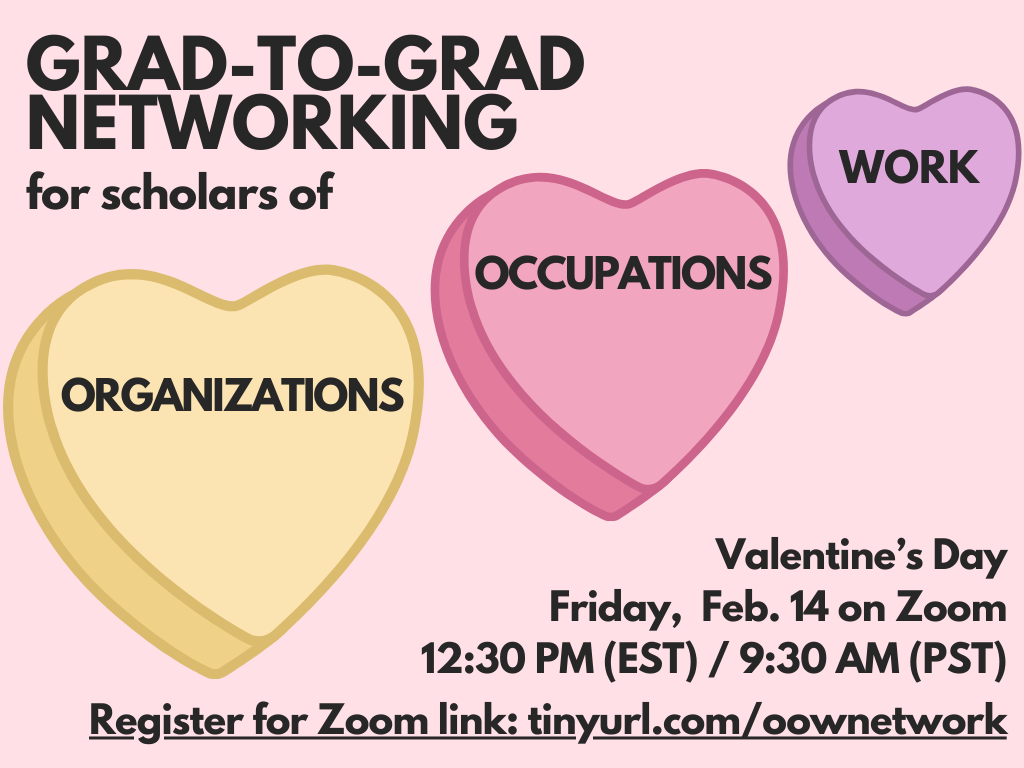
Grad-to-Grad Networking

Grad-to-Grad Networking for Scholars of Organizations, Occupations, and Work

February 14, 2025

12:30-1:30 PM (EST) / 9:30-10:30 AM (PST)

Zoom (registration at tinyurl.com/oownetwork required to receive link)

This virtual event is an opportunity for graduate students who study organizations, occupations, and work to meet peers with similar interests. The event is open to any graduate student with these interests; membership in ASA or the OOW section is not required. 

Research shows that lateral, peer-to-peer relationships are a meaningful resource for people building their careers. We hope this event can be a springboard for further in-person or virtual collaboration, information-sharing, and connection. Who knows? You might make a new friend, meet a new co-author, or just get more comfortable talking to others about your research.

Register to receive the Zoom link at: tinyurl.com/oownetwork. If you have any questions, please contact Ewa Protasiuk (ewa.protasiuk@temple.edu) or Victoria Zhang (vzhang3@mit.edu).

Call for Abstracts: The Organization of Illegal Marketplaces; Institute of Sociology, University of St.Gallen, Switzerland; Due Dec 1, 2024

PAPER DEVELOPMENT WORKSHOP (PDW)

THE ORGANIZATION OF ILLEGAL MARKETPLACES


April 3 & 4, 2025, Institute of Sociology, University of St.Gallen, Switzerland

Abstract Submission:
Please send an abstract of 500 words and a short biographical note to gdumont@emlyon.com and loic.pignolo@unisg.ch by December 1, 2024. Notification of acceptance will be sent by January 1, 2025.

Papers must be submitted by March 6, 2025. There is no registration fee. They will cover lunch on both days and the dinner on the first day. Partial grants for travel and accommodation can be provided to a small number of participants with limited resources. Please indicate if you require financial support. Participation in the workshop is open to all upon registration.

Please click on the link for more details: https://oowsection.org/wp-content/uploads/2024/10/cfp-pdw-the-organization-of-illegal-marketplaces.pdf

Organizing Committee:
Loïc Pignolo, Universität St. Gallen, Switzerland
Guillaume Dumont, Emlyon Business School, France

Illegal marketplaces are “organized places, whether physical (e.g., a weekly trading event in the town square) or virtual (e.g., an electronic platform, such as Etsy) for ztrade” (Aspers and Darr, 2022; p.824). They operate based on shared norms, roles, meanings, and routines implemented by marketplace organizers or derived from mutual adjustment among actors, thereby shaping trade in important ways (e.g., Aspers and Darr, 2022; Dewey and Buzzetti, 2024; Tzanetakis, 2018; Tzanetakis et al., 2016). They offer the means to facilitate illegal transactions and provide opportunities and sources of power for marketplace organizers through place-based cooperation, gathering of people, infrastructure, digital technologies, and/or pooling of resources. No less importantly, they are a focus of attention for policymaking and law enforcement, with most state institutions striving to eradicate them (e.g., Beckert and Dewey, 2017; Coomber et al., 2019; Gottschalk, 2010; Paoli, 2014).

Whether online or offline, illegal marketplaces are places where the dynamics of markets, illegality, state institutions, vulnerability, and power intersect, raising important questions that have yet to be addressed by the emerging stream of scholarship in this field: What social, spatial, and technological conditions allow for the emergence of illegal marketplaces? How are they organized to face the coordination problems associated with illegality? Who are the organizers, how do they make decisions, and what resources do they use? How do they help to set prices, facilitate product supply, and protect traders? Who are the market participants, and how is power distributed among them? What are the differences between online illegal marketplaces and physical ones?

This third edition of the “Ethnographies of Illegality” Paper Development Workshop (PDW) will focus on selected organizational and managerial aspects of illegal marketplaces. We welcome proposals that investigate illegal marketplaces using ethnographic and, more broadly, qualitative approaches and address one or more of the following four themes.

Regulation: Illegal marketplaces are legally embedded, making the study of regulations and legal frameworks crucial for understanding them. The fourth theme explores the relation between illegal marketplaces and their local regulatory contexts. We encourage authors to uncover the complexity of the relation between state institutions and law enforcement agencies, their role in shaping markets, and marketplaces’ organizational, spatial, and working characteristics.

By exploring these themes across contexts and activities, the workshop aims to produce new knowledge in three areas: the infrastructure(s) and organizations that enable illegal marketplaces to emerge, grow, and transform; the contemporary cultural forms of illegal exchange in different geographical locations; and the differences and similarities between illegal marketplaces and their legal counterparts.

Organization: The operation of illegal marketplaces requires organizational structures, governance, and cultures, as well as conventions, maintenance, and development strategies. This theme focuses on the organizational aspects, particularly the organizational forms, rules, monitoring mechanisms, and sanctions enabling the operation of illegal marketplaces, as well as the socialization of market participants, their coordination problems, and power distribution.

Space: Illegal marketplaces are often located at the intersection of online and offline spaces. This theme focuses on rethinking the notion of space in relation to illegal marketplaces. We encourage authors to consider how market participants appropriate specific spaces and places to develop their activities and how multiple spaces are intimately connected in the design and operation of marketplaces.

Work: Illegal marketplaces involve the work and labor of different actors. This third theme will approach the activities and tasks performed in markets and marketplaces through the conceptual lens of work, allowing for the exploration of essential aspects of their functioning, such as the division of labor, labor relations among actors, consequences of organizational elements for their working conditions and careers, and meaning of their work.

Update: OOW Book Discussion – Work, Pray, Code 

OOW Book Discussion: New date – January 22

All OOW members are invited to participate in an informal, online discussion of Catherine Chen’s Work, Pray, Code on January 22nd, 12-1pm EST. The book is a brisk, qualitative study of how work becomes religion in Silicon Valley. The conversation will be “book club style”, with everyone welcome to share ideas. (If you’d like to participate but time is short, focus on the introduction & chapter 4.) 

We hope students and faculty alike come to discuss and meet with fellow OOW members. To register and receive a zoom link, click here.

Questions? Contact Laura Doering (laura.doering@utoronto.ca).

Upcoming Event: Socio-Economic Review Cafe— Close Relationships, Trust, and the Economy

Socio-Economic Review Cafe: Close Relationships, Trust, and the Economy

Featuring a conversation with SER authors Wenjuan Zheng (Hong Kong University of Science and Technology), David Shulman (Lafayette College), and Kent Grayson (Northwestern University) 

Join us for a discussion of close relationships and the potential and pitfalls of trust in the economy, as well as the ways technology can mediate these dynamics. Shulman and Grayson’s paper “Et Tu, Brute? Unraveling the puzzle of deception and broken trust in close relations” (2023)  discusses why closeness, as with friends or coworkers, is no guarantee of trust, revisiting theoretical discussions of trust to shed light on detection errors and associational dilemmas. Meanwhile, Zheng’s paper “Converting donation to transaction: how platform capitalism exploits relational labor in non-profit fundraising” (2023) investigates what happens when platforms intermediate trusting relationships, demonstrating how they reconfigure charity events and mediate civic interactions through invisible value extraction. 

Together, these papers offer insights into how trust is built, maintained, and challenged in a world increasingly facilitated by technology. 

The event will take place on Thursday, November 16th, at 9AM PST/12PM EST/6PM CET. Register at this link!

As with all SER Cafe events, we will facilitate a dynamic conversation with the authors rather than lengthy talks. Come ready to engage. 

CFP: Stone Center for Inequality Dynamics Visiting Fellowship

The Stone Center for Inequality Dynamics (CID) at the University of Michigan is now accepting applications for a Visiting Fellow for the 2024-25 academic year.

The fellowship provides an early-career social scientist with funded time to pursue their research in an intellectual community with a culture of engagement and collaboration.

Applications are due by December 1, 2023. For more information, please visit: https://www.inequalitydynamics.umich.edu/opportunities/staff/visiting-fellowship

Upcoming Event: City & Community Presents: “How to Write (and Not Write) Journal Articles”

City & Community Presents: “How to Write (and Not Write) Journal Articles”A Virtual Professional Development EventThursday, October 19, 6:30-8 pm EST, on Zoom. 

Aimed primarily at doctoral students and early career scholars, this virtual information session is meant to offer first-time authors some guidance in journal article writing from the perspective of an editor. Richard Ocejo, editor of City & Community, will offer some practical tips and common mistakes authors make in papers. Attendees will also get ample opportunity to ask questions about the process and to receive writing advice. While City & Community and urban sociology will serve as the main examples, scholars with interest in other subfields and journals are welcome to attend. Registration required: https://jjay-cuny.zoom.us/meeting/register/tZIucOGvrT8tEtNjFBzmdbvcLTrlVQNkQONF 

Please email cicojournal@gmail.com with any questions.

Summer Workshop: XV Medici Summer School, The Rise of the Platform Economy and its Implications

XV Medici Summer School, June 11-16, 2023

Theme: The Rise of the Platform Economy and its Implications

Website: https://www.bbs.unibo.eu/xiii-medici-summer-school/#

We are pleased to announce the organization of the 15th edition of the Medici Summer School in Management Studies for doctoral students and young researchers which will be held at MIT Sloan, June 11-June 16, 2023. The school is organized and sponsored by Bologna Business School (University of Bologna), HEC Paris (Society and Organizations Institute), and the MIT Sloan School of Management (Economic Sociology PhD Program).

The School will admit 20-25 student participants. Applications are welcome from current Ph.D. students in Management, Strategy, Organization Theory, Economic Sociology, and related disciplines from universities worldwide. Students for the Summer School will be selected in accordance with the quality of their doctoral curricula, research interests, and application materials. Applications from students who have completed at least two years of doctoral training will be considered, with preference given to those who have satisfied their course requirements and qualifying exams but have not yet embarked on their dissertation research. Applications from post-docs will also be considered.

There is no application or participation fee. Student participants will be responsible for covering their own travel expenses to and from MIT, but the Summer School will cover accommodation and board expenses during the week of sessions provided that students attend the entire week.

All application materials should be sent by March 15th, 2023 exclusively via email to the following address: medici2023@mit.edu with application Medici Summer School in the subject of the email. For any specific inquiry or clarification please also contact medici2023@mit.edu. Admitted candidates will be notified by April 1th, 2023.

Please see website for more information and application details: https://www.bbs.unibo.eu/xiii-medici-summer-school/#