Call for Abstracts: ISA RC17 Sociology of Organizations, Gwangju 2027

The Research Committee on Sociology of Organizations (RC17) invites abstract submissions for 27 themes at the upcoming ISA conference in Gwangju, Republic of Korea, July 4–10, 2027. The themes cover a wide range of current topics in organizational sociology.


XXI ISA World Congress of Sociology
Gwangju, Republic of Korea
July 4-10, 2027

Deadline for abstract submissions: October 14, 2026, 23:59 UTC/GMT
Maximum abstract length: 300 words

The Research Committee on Sociology of Organizations (RC17) invites abstracts for 27 themes open for abstract submissions, covering a wide range of current themes in organizational sociology.

Please find below the RC17 themes open for abstract submissions. Click on the theme title to read the full Call for Abstracts and submit your contribution.

·         Business and Society Relations In Twenty-First-Century East Asia
organized by Jiwook Jung

·         DEI, Aging, and Corporate Responsibility: Organizations, Discrimination, and the Care of Older Adults
organized by Soohan Kim

·         Diversity and Organizations – Debates from Transnational, National or Regional Perspectives
organized by Maja Apelt, Matthias Schneider and Nina Hossain

·         Educational Organizations, Diversity, and Digital Technologies: Examining Inclusion and Exclusion
organized by Svenja Hammer, Robert Aust and Caroline Vincent

·         Forging Global Alliances: Food Security, Preparedness, and Agroecological Resilience In Turbulent Times
organized by Allison Loconto and Hilde Bjørkhaug

·         Governing Digital Transformation In Organizations
organized by Angela Graf, Sabine Pfeiffer, Klarissa Lueg and Marco Blank

·         Meta-Organizations and Alternatives to Dominant Orders
organized by Héloïse Berkowitz, Florence Lanzi and Fabian Maier

·         Micro-Sociology of Organizations: What Can It Offer?
organized by Nadine Arnold and Lars Klemsdal

·         Organization and Expertise: Producing, Stabilizing, and Contesting Knowledge
organized by Kathia Serrano Velarde and Leopold Ringel

·         Organization, De-Institutionalization, and Alienation: Education, Care, and Welfare and the New Authoritarianism
organized by Dirk Michel-Schertges and Michael Grothe-Hammer

·         Organizational and Algorithmic Rationalities: Decision-Making, Power and Control In Contemporary Organizations
organized by Marco Joestingmeier and Uli Meyer

·         Organizations Shaping and Being Shaped By Migration
organized by Yingjian Liang

·         Organizing Creativity with AI: Creative Industries, Organizational Fields, and the Reconfiguration of Expertise
organized by Angela Graf, Sabine Pfeiffer and Marco Blank

·         Organizing Education
organized by Kathia Serrano-Velarde and Rebecca Ye

·         Organizing Political Displacement: Expertise, Bureaucracy and the Neutralization of Conflict
organized by Amel Boubekeur

·         Organizing Waste for Livable Lives
organized by Nadine Arnold, Héloïse Berkowitz, Simone Di Cecco, Karine Guiderdoni-Jourdain and Devi Vijay

·         Organizing from the South: Coloniality, Emergences and Alternatives In Latin America
organized by Alba González Vega, Lorena Litai Ramos and Ayde Cadena López

·         Policy Change In Overorganized Societies
organized by Patrick Castel and Henri Bergeron

·         Professions and Organisations Facing Turbulent Times: The Role of Technology
organized by Lia Tirabeni and Lara Maestripieri

·         Racial Inequality In Organisations: The Role of Attitudes, Emotions and Organisational Culture
organized by Carolin Schütze

·         Senior Employment In Organizations
organized by Christophe Baret, Tomohiko Moriyama and Kihong Kim

·         Systems, Decisions, and Organization: From Cybernetic Legacies to Contemporary Challenges
organized by Ayumi Higuchi and Michael Grothe-Hammer

·         The AI-Magicalized Double Movement: Transforming Social Institutions
organized by Jelica Stefanovic Stambuk and Nikola Lazic

·         The Contested Worth of Academic Knowledge
organized by Kate Williams and Liz Dean

·         The Futures of Doing Research In the Social Sciences In the Era of Generative Artificial Intelligence (GenAI): What Can We Do? What Should We Do?

organized by Inga Gaizauskaite, Michael Grothe-Hammer, Dirk Michel-Schertges and Markus S. Schulz

·         The Organization of Ignorance
organized by Robert Van Krieken

·         The Social Regulations of Shared Objects and Spaces In Organizations
organized by Nathalie Saadia Richebé and Lea Holm-Jensen

Abstracts must be submitted through the ISA Conference System to one specific theme/session. Please consult the individual theme page for the full description and accepted language(s).

We very much encourage you to submit your work and to share the Call for Abstracts with colleagues who may be interested.

If you have any questions, please do not hesitate to contact us.

We hope to see many of you in Gwangju!

Best wishes,
Michael Grothe-Hammer
Robert van Krieken
Program Coordinators, RC17 Sociology of Organizations
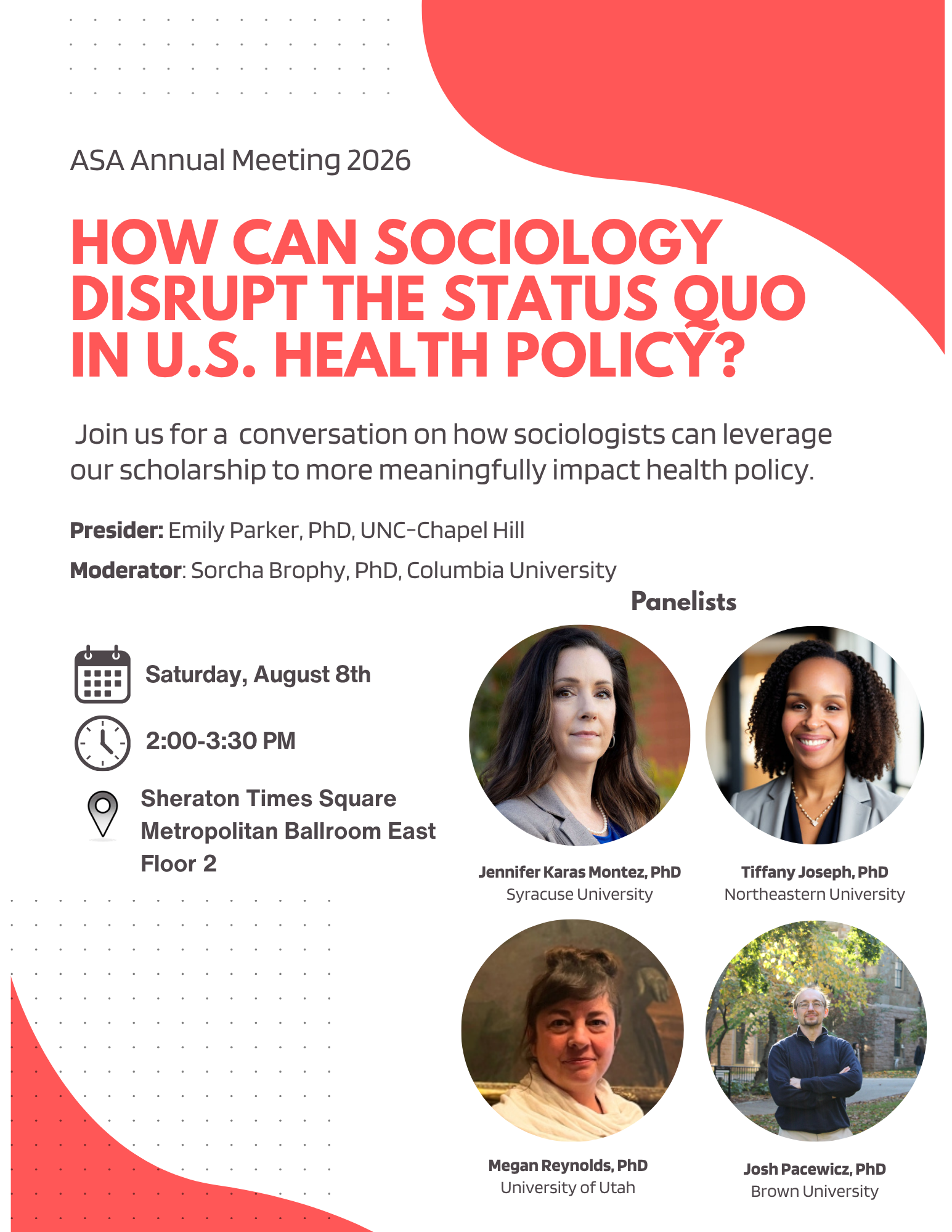

ASA Thematic Session: How Can Sociology Disrupt the Status Quo in U.S. Health Policy?

OOW members attending the 2026 American Sociological Association Annual Meeting may be interested in the following thematic session:

Session 20834: How Can Sociology Disrupt the Status Quo in U.S. Health Policy?

Saturday, August 8, 2:00–3:30 p.m.
Sheraton, Second Floor, Metropolitan Ballroom East

Description: Under the current presidential administration, we have seen significant threats to healthcare access, public health, and health promoting social policies in the U.S. Despite our discipline’s theoretical frameworks and methodological tools, sociologists have often ceded health policy leadership opportunities to adjacent fields. This session asks: How can sociologists more meaningfully impact health policy? What core sociological insights can animate research agendas to disrupt the status quo in health policy? How can we position existing scholarship and produce new knowledge to meet this political moment? This panel will feature scholars working across multiple areas to invite a conversation on how our discipline can catalyze change in health policy.

Presider: Emily Parker, University of North Carolina-Chapel Hill
Moderator: Sorcha Brophy, Columbia University

Panelists:

  • Tiffany Joseph, Northeastern University
  • Jennifer Karas Montez, Syracuse University
  • Josh Pacewicz, Brown University
  • Megan Reynolds, University of Utah

Announcement: The Work and Family Researchers Network Conference will be held June 17-20, 2026, at Concordia University in Montreal, Canada

The next Work and Family Researchers Network Conference will be held June 17-20, 2026, at Concordia University in Montreal, Canada.

The conference theme is Centering Care Across the Life Course. More than 500 stakeholders in the work-family field are anticipated to attend, and the dynamic program will focus on meaningful exchanges.

Submissions open in July and close November 1, 2025.

More information can be found at https://wfrn.org/2026-work-and-family-researchers-network-conference/.

WORK2025 Conference “Work in the Era of Unruly AI” from August 20-22, 2025 in Turku, Finland (also online)

The multidisciplinary, international WORK2025 conference is from August 20-22, 2025, at the University of Turku and online. WORK2025 offers 19 exciting research streams, five inspiring keynote talks, and nice breaks between the sessions to share knowledge, research results, and discuss new directions in research.

The main theme of WORK2025, “Work in the era of unruly AI,” will explore the “unruliness” of AI in contemporary working life. WORK2025 calls upon presentations and posters to address the main theme and various issues related to work and working life. WORK2025 welcomes abstracts from a wide variety of interdisciplinary, empirical, and theoretical perspectives.

Check out the streams and submit your abstract no later than February 20, 2025 at www.work2025.fi!

CALL FOR ASA OOW SECTION SESSION SUBMISSIONS – CHICAGO 2025

CALL FOR ASA OOW SECTION SESSION SUBMISSIONS – CHICAGO 2025

The OOW call for submissions for our annual conference is now out!
Call for Submissions: https://www.asanet.org/2025-annual-meeting/call-for-submissions/

Section Sessions: https://www.asanet.org/2025-annual-meeting/call-for-submissions/papers-extended-abstracts/section-sessions/

1 – Organizations
We invite paper submissions under the broad topic of organizations, including studies that assess the implications of their structures, norms, policies, and practices.
(Session Organizer) Elizabeth A. Armstrong, University of Michigan; (Session Organizer) Matthew Clair, Stanford University 

2 – Professions and Occupations
We invite paper submissions on the broad topic of professions and occupations, including studies that focus on their emergence, evolution, and implications. 
(Session Organizer) Nicholas Occhiuto, Hunter College; (Session Organizer) Alexandrea Ravenelle, University of North Carolina, Chapel Hill 

3 – Gender Inequality in Organizations
We invite paper submissions under the topic of gender inequality in organizations.
(Session Organizer) Sharla Alegria, University of Toronto; (Session Organizer) Alexandra Kalev, Tel-Aviv University

4 – Labor Markets
We invite paper submissions under the broad topic of labor markets, including studies that examine their structures, dynamics, and consequences.
(Session Organizer) Koji Chavez, Indiana University; (Session Organizer) Steve McDonald, North Carolina State University

5 – Future of Work
We invite paper submissions under the broad topic of the future of work.
(Session Organizer): Angèle Christin, Stanford University; (Session Organizer) Steve Vallas, Northeastern University

6 – Informal and Unregulated Economies
We invite paper submissions under the topic of informal and unregulated economies, including studies that examine migrant and transnational dynamics.
(Session Organizer) Rhacel Salazar Parreñas, Princeton University; (Session Organizer) Patricia Ward, Bielefeld University

7 – AI in the Workplace (joint with Communication, Information Technologies, and Media Sociology section)
We invite paper submissions under the topic of Artificial Intelligence (AI) in the workplace. (NB: Thanks to a special relationship between the Communication, Information Technologies, and Media Sociology (CITAMS) section and the journal Information, Communication & Society (ICS), all papers with a theme of information, communication, or media that are presented at the 2025 meetings of the ASA are eligible for submission to a special issue of ICS edited by the CITAMS chair each fall.)
(Session Organizer) Barbara Kiviat, Stanford University; (Session Organizer) Simone Zhang, New York University.

8 – Section on Organizations, Occupations, and Work Refereed Roundtables
(Session Organizer) Michel Anteby, Boston University; (Session Organizer) Sigrid Luhr, University of Illinois, Chicago

https://oowsection.org/wp-content/uploads/2024/11/call-for-submissions_asa_2024.docx

Conference Call: Organizing Plurality – INTERNATIONAL CONFERENCE ON ORGANIZATIONAL SOCIOLOGY (ICOS), March 2025 in Hamburg, Germany

Organizing Plurality

INTERNATIONAL CONFERENCE ON ORGANIZATIONAL SOCIOLOGY (ICOS)

March 27 & 28, 2025  Hamburg, Germany

Call for Abstracts is now open!

Submission Deadline: November 30, 2024

The German Section of Organizational Sociology and its European peers are organizing the International Conference on  Organizational Sociology ICOS 2025 at Helmut-Schmidt-University Hamburg, Germany, in March 2025.

The main topic is “Organizing Plurality,” which will be discussed in relation to several societal trends:
1) Organizations and  Valuation
2) Organizations and Sustainability
3) Organizations and Digitalization
4) Organizations and Governance

Additional details can also be found on the pdf: icos2025_organizing-plurality.pdf

You can find the full Call for Papers and more information on their homepage, icos2025.com.

Announcement: Submit to the ISA Session on “New Digital Technologies, Power and Work: Labor Control and Resistance” by October 15

Please consider submitting by October 15 to a  “New Digital Technologies, Power and Work: Labor Control and Resistance” session at the International Sociological Association Forum on Sociology in Rabat, Morocco, 6-11 July 2025. 

Please see the link below for a detailed description:
https://isaconf.confex.com/isaconf/forum2025/webprogrampreliminary/Session19472.html

If you are interested in submitting an abstract for this session, the Call for Abstracts is at https://www.isa-sociology.org/en/conferences/forum/rabat-2025/5th-isa-forum-call-for-abstracts.

The call closes on October 15th (note that the ISA observes Central Europe Time).

“If you have not attended ISA before, it is truly an international sociology conference with distinct inflections in each location where it meets—I have found every ISA conference I have attended to be fascinating, and of course, Rabat itself is a very interesting place in a very interesting region. In addition to this session, I encourage you to scan other possible sessions (Research Council 44 is the ISA’s Labor Movements section; RC 30 is the Sociology of Work).”
– Dr. Tilly, Professor of Urban Planning and Sociology, UCLA Luskin School of Public Affairs

CALL FOR ABSTRACTS: 11h edition of the Ethnography Workshop, ESADE Business School, May 6-7, Barcelona

We are pleased to announce that the 11th edition of the Ethnography Workshop will be hosted by ESADE Business School, on May 6 and 7, 2024, in Barcelona, Spain.

This workshop, created in 2013, is designed as a convivial space where you can share the peripeties of your ethnographic journey and think both through and beyond your observation with an interdisciplinary group of scholars (e.g., Management, Sociology, Anthropology, Entrepreneurship).

The workshop aims to foster a space for experimentation, play, and critique to engage ethnographically on a wide variety of topics. Discussing empirics, reflexive matters, issues of engagement and relationships with the field, are central to our conversations.

Participation is free of charge, and refreshments and meals are provided but participants are expected to cover their travel and accommodation expenses. Three emlyon Ethnography Institute grants of 500 euros are available to support participants with limited funding.

  • Abstract (500 words) are due by March 1st, 2024, to blum@em-lyon.com.
  • Notification of acceptance on March 18th and full paper due by April 28th.

More info here: https://oce.em-lyon.com/2023/06/19/ethnoworkshop/

Call for Submissions: EGOS 2024, Sub-theme: Organising beyond hierarchy?

Sub-theme title: Organising beyond hierarchy?

Big societal challenges such as the climate crisis, proliferating democracy deficits, intensifying casualisation and digitalisation of work and widening inequalities require rethinking the ways we organise to achieve change. Professions and professional organizations have often challenged established bureaucratic was of organizing and have provided alternatives such as partnerships and collegial forms, aiming to maintain high degrees of autonomy. In this stream, we invite you to think about organising beyond hierarchies in professional settings in the public, private or civil sectors and to ponder with us how alternative forms of organising might challenge or affirm the status quo, lead to or stagnate progress, advance or hinder equalities.

Full call for papers:

Submission deadline: Tuesday, January 9, 2024

Stream convenors:

Johan Alvehus, Lund University, Sweden

Perttu Salovaara, Helsinki University, Finland

Nela Smolović Jones, The Open University, United Kingdom

CFP: SASE Annual Meeting and Network A: Community, Democracy, and Organizations

Please consider submitting an abstract of about 500 words for an individual presentation or a panel relating to community, democracy, and organizations at the Society for the Advancement of Socio-Economics (SASE) annual meeting. The conference submission deadline is Jan. 19, 2024. Our 2024 annual meeting will primarily be an in-person conference spanning 3 days in Limerick, Ireland, June 27-29, 2023. For those unable to travel, our network—Network A: Community, Democracy, and Organizations—also have a very limited number of virtual presentation slots in two sessions to be scheduled for June 18-21. (Details about those are here.)

As the organizers of Network A: Community, Democracy, and Organizations, we would be glad to consider any papers on our network’s topics that you wish to submit, in addition to any ideas you have for pre-formed panels with multiple paper presentations, roundtable discussion panels, or book salons (aka Author Meets Critics panels). SASE is an international organization of scholars who study topics related to economic sociology and political economy. Network A focuses on the moral or values-based underpinnings of human thought, practices, and institutions that comprise civil societies, particularly as they relate to the participatory, collectivist, and democratic aspirations of organizations, markets, and other spaces of collaboration and contestation. We examine how communities, enterprises, and societies can be organized around principles of democratic governance or other substantive values that go beyond calculative self-interest and instrumental relations. In particular, we welcome submissions relating to: (1) how groups and initiatives promote social change, through formal organizations, informal groups, prefigurative organizations, decentralized projects, participatory decision-making, and various forms of shared ownership; and (2) how collectivities reinforce prevailing conventions of hierarchical, bureaucratic, and profit-driven organizational structures and markets.

Examples of relevant phenomena include, but are not limited to: affinity groups; anti-oppressive human services; artistic or cultural collectives (including democratic governance and autonomy-respecting practices in creative organizations more broadly); collectively governed commons; community land trusts; community real estate investment cooperatives; community-based economic exchanges; community-run marketplaces; decentralized autonomous organizations (DAOs); free schools; giving circles; limited equity housing cooperatives and co-housing; mutual companies and aid networks; open, commons-based, and inclusive innovation and valuation frameworks; participatory budgeting; public-private partnerships; social enterprises; solidarity economies; and worker, producer, or consumer cooperatives, including platform cooperatives.

To learn more about our network and its history, please read here. To join our Network A listserv, visit https://inthefray.org/list.

For more information about the 2024 conference, visit https://sase.org/event/2024-limerick/#submissions.

How to submit to the 2024 SASE annual conference:

If you are interested in presenting in person or virtually, please submit your paper title(s) and abstract(s) to https://auth.oxfordabstracts.com/?redirect=/stages/6679/submitter and select “Network A: Community, Democracy, and Organizations” by Jan. 19, 2024.

SASE’s Early Career Workshop brings together PhD students, recent PhDs, and independent scholars who wish to participate in small roundtable discussions of their work with assigned faculty mentors. It is held in person shortly before the SASE annual meeting, with some travel expenses paid. Applicants should submit full papers and other required materials, as specified here, by Jan. 19, 2024.

Please direct any general questions or comments about Network A to sase@inthefray.org.

How to support Network A:

Network A relies entirely on the efforts of volunteer organizers and additional support from colleagues at all stages of their careers. Please consider supporting the growth and sustainability of our community in these and other ways: 

(1) Circulate this cfp to listservs and other potentially interested parties, particularly those who might not have heard of our network or the SASE conference.  

(2) Help us build community at the SASE conference in Limerick, Ireland. Among other things, please send us suggestions for local venues, local organizations, or other groups that might be of interest to our network’s members and that could possibly present at the conference, host field trips for our members, etc.  

(3)  Consider becoming  part of the Network A leadership. There are many ways to help, including by organizing conference panels, social events, and virtual sessions. 

We look forward to reading your submissions!

Best wishes from your SASE Network A organizers,

In-person team

Katherine K. Chen, kchen@ccny.cuny.edu

Victor Tan Chen, vchen@vcu.edu 

Philipp Degens, Philipp.Degens@uni-hamburg.de 

Virtual session team

Joyce Rothschild, joycevt@aol.com 

Marc Schneiberg, schneibm@reed.edu

Coordination team

Paola Ometto, pometto@csusm.edu