2025 ASA OOW SECTION AWARDS

Congratulations to the 2025 award recipients for their achievements!

Dr. Heather A. Haveman (middle) received the Rosabeth Moss Kanter Distinguished Career Award for 2025

Dr. Katherine Sobering won the 2025 Max Weber Book Award for her book The People’s Hotel: Working for Justice in Argentina (Duke University Press, 2022).

Anna Fox (left) won the James Thompson Graduate Paper Award for her paper “Covalent Logics: Policing, Family Values, and the Reproduction of Inequality.”
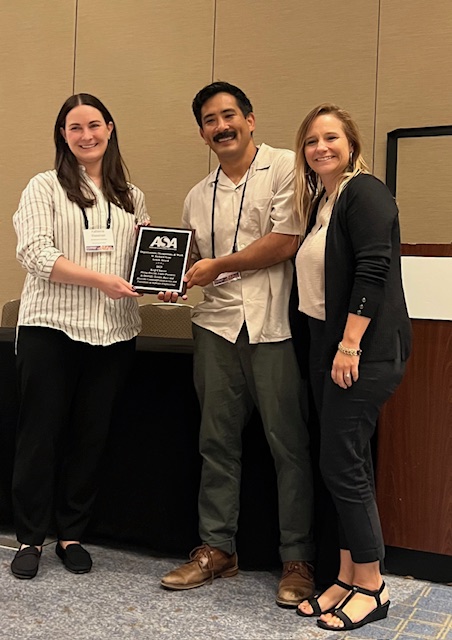
Dr. Katherine Weisshaar (left), Dr. Koji Chavez (in the middle), and Dr. Tania Hutt (not in the picture) won the W. Richard Scott Article Award for their paper “Hiring Discrimination Under Pressures to Diversify: Gender, Race, and Diversity Commodification across Job Transitions in Software Engineering,” published in American Sociological Review.

New Publication: “Positioning Stories: Accounting for Insecure Work” by Kathleen Griesbach

Griesbach, K. (2025). “Positioning Stories: Accounting for Insecure Work”. American Sociological Review, OnlineFirst. https://doi.org/10.1177/00031224251328393

Abstract: How do structural features of work shape workers’ interpretations of precarity, or the stories they tell? This article draws on 120 interviews with four groups of workers who confront temporal and spatial instability: Texas-based agricultural and oilfield workers and NYC-based adjunct instructors and delivery workers. I find that rather than adopting one dominant individualizing story, as previous research suggests, workers instead move between what I call positioning stories: narratives that interpret their work’s particular structural features. In doing so, workers combine individualistic and structural frames to cope with their positional uncertainty. Depending on the specific tempo and geography of their work, workers account for spatial instability in stories about sacrifice and self-improvement; they interpret temporal instability in stories about addiction and the burden of time passing without progress. Workers combine these with stories highlighting meaning and exploitation in their labor process. These findings reveal how structural precarity impedes a cohesive narrative by disrupting identities and life projects, but it also undermines the credibility of individualistic accounts. The resulting narrative fragmentation may inspire a wide range of responses, from resignation to contestation.