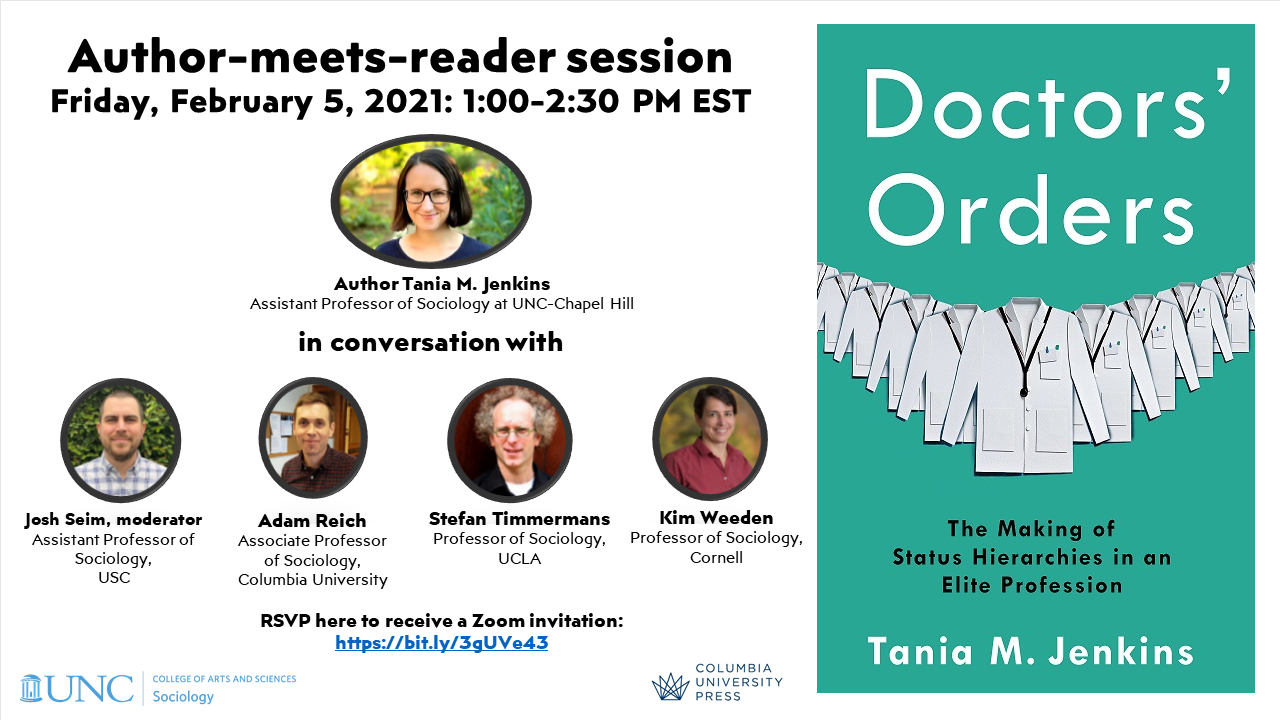
Please join us for an author-meets-reader session for UNC Sociology assistant professor, Tania Jenkins’, new book Doctors’ Orders, on Friday, February 5 from 1:00-2:30P EST.
The event will be moderated by Josh Seim (University of Southern California), with comments from Adam Reich (Columbia University), Stefan Timmermans (UCLA), and Kim Weeden (Cornell University).
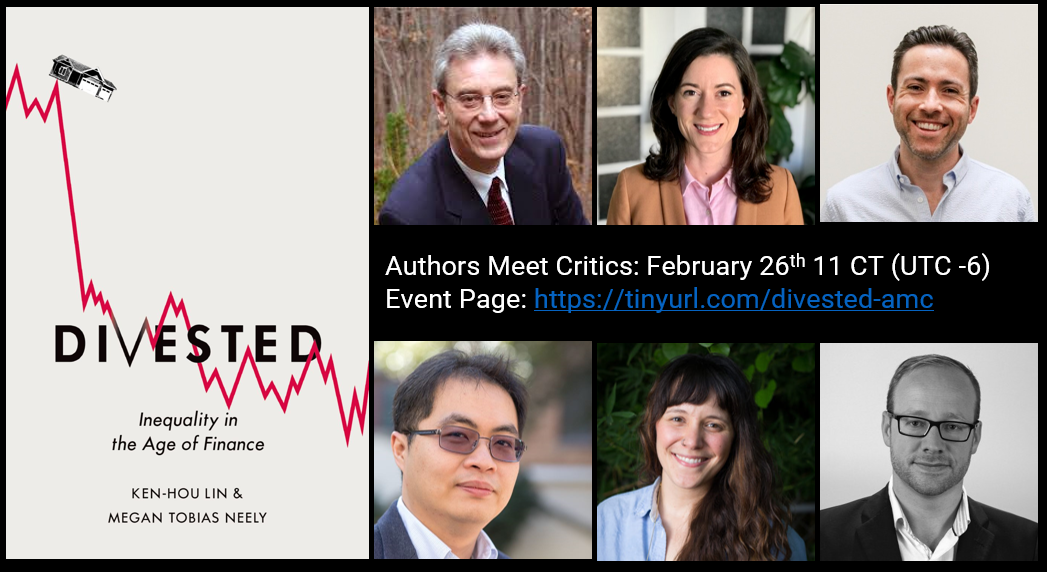
Date: Feb 26th 2021 Time: 11AM-12:30PM Central Time (UTC -6) (https://www.thetimezoneconverter.com/) Location: Zoom (The link will be distributed before the event)
Moderator: Katie Sobering, University of North Texas
Panelists: Arne Kalleberg, University of North Carolina at Chapel Hill Jake Rosenfeld, Washington University in St. Louis Fabian Pfeffer, University of Michigan
Authors: Ken-Hou Lin, University of Texas at Austin Megan Tobias Neely, Copenhagen Business School
Two theoretical paradigms namely, the ‘resource curse’ and ‘developmental state’ wouldpredict that industrial development in countries with abundance of capital-intensive natural resourcesand in states with patrimonial tendencies is doomed to failure. Iran’s success in developing adynamic auto industry, which in 2011 became the world’s 12th largest automobile manufacturer with1.6 million vehicles produced per year seems to contradict these perspectives. How was this technicalcapacity created in an oil-based economy—which provides little incentive for industrialization—and, in a country that has been under the United States and international sanctions since 1979Revolution? In this paper, I will expand on the implications of these theoretical traditions to identifythe structural factors that enabled the Iranian state to develop a large automobile sector and relativelydiversify the economy.
Weber famously invoked ‘ideal types’ as an analytic device with which to measure empirical reality against some hyper-rational fabrication. Case in point: non-professional (lay) investors appear to be the antithesis of rational economic man. They have been cast as less-informed, less-skilled, and less-knowledgeable than professional market practitioners, and with ample evidence that they tend to lose money in the market as a result. This study builds the case that a new class of algorithmic financial advisor, commonly known as ‘roboadvisors’, enacts lay investors as rational market actors. This is achieved through algorithmic devotion to modern portfolio theory (MPT), which the roboadvisors embody, automate and perform, conjuring some version of homo economicus into existence. Through this example, I show how Weberian ideal types and the particular kind of rational action associated with them (e.g. the ideal type investor) become the very empirical reality they were intended to be a foil to – accomplished through the technological articulation of financial models, even in the hands of ordinary individuals.
Qualitative interviewing is among the most widely used methods in the social sciences, but it is arguably the least understood. In The Science and Art of Interviewing, Kathleen Gerson and Sarah Damaske offer clear, theoretically informed and empirically rich strategies for conducting interview studies. They present both a rationale and guide to the science-and art-of in-depth interviewing to take readers through all the steps in the research process, from the initial stage of formulating a question to the final one of presenting the results. Gerson and Damaske show readers how to develop a research design for interviewing, decide on and find an appropriate sample, construct a questionnaire, conduct probing interviews, and analyze the data they collect. At each stage, they also provide practical tips about how to address the ever-present, but rarely discussed challenges that qualitative researchers routinely encounter, particularly emphasizing the relationship between conducting well-crafted research and building powerful social theories. With an engaging, accessible style, The Science and Art of Interviewing targets a wide range of audiences, from upper-level undergraduates and graduate methods courses to students embarking on their dissertations to seasoned researchers at all stages of their careers.
You can find more about the book and buy it on the Oxford University Press website—where you can use the promo code ASFLYQ6 for a 30% discount— or on Amazon.
Despite the importance of including diverse populations in biomedical research, women remain underrepresented as healthy volunteers in the testing of investigational drugs in Phase I trials. Contributing significantly to this are restrictions that pharmaceutical companies place on the participation of women of so-called childbearing potential. These restrictions have far-reaching effects on biomedical science and public health. Using 191 interviews collected over three years, this article explores the experiences of 47 women who navigate restrictions on their participation in U.S. Phase I trials. Women in this context face a number of contradictory criteria when trying to enroll, which can curtail their participation, justify additional surveillance, and deny pregnant women reproductive agency. The pharmaceutical industry’s putative protections for hypothetical fetuses exacerbate inequalities and attenuate a thorough investigation of the safety of their drugs for public consumption. We use the framework of “anticipatory motherhood” within a gendered organizations approach to make sense of women’s experiences in this context.
The study of occupations as a locus for social stratification research has a long and distinguished history in sociology. The authors in this issue present different perspectives on the current and future role of occupations as a foundation for inequalities research. This introduction provides a context for understanding how and why occupations became a focus of inequalities research, especially in the Post-World War II English-speaking world. I then discuss some of the economic changes that have led some to question where occupations stand as a vehicle for analyzing social inequality, and then turn to a summary of the contributions to this issue. This summary is framed as a friendly family debate between those who wish to “fix and refurbish” the old reliable occupational perspective and those who think that researchers should “trade in” the old perspective for one focusing on firms and jobs. My review of the contributions to this issue suggests several avenues for future research including (1) new efforts to improve the quality of occupational coding, (2) a renewed focus on local labor markets as a better representation of where most people find employment, (3) an examination of whether occupational structures mattered more for explaining social inequalities in prior historical periods compared to the present, (4) examinations of how and where occupations matter cross-nationally, and finally (5) a renewed focus on units of measurement that people actually carry around with them and spend (dollars, euros, etc.) as opposed to logged earnings and socioeconomic status points. In an age of record high and rising inequality, the core question of social stratification research really comes down to “What’s in your Wallet”?
This paper makes the case for an inhabited institutionalism by pondering questions that continue to vex institutional theory: How can we account for local activity, agency, and change without reverting to a focus on individual actors—the very kinds of actors that institutional theory was designed to critique? How is change possible in an institutional context that constructs interests and sets the very conditions for such action? Efforts to deal with these questions by inserting various forms of individual, purposive actors into institutional frameworks have created inconsistencies that threaten the overall coherence of institutional theory and move it farther from its sociological roots. To provide alternative answers, we turn to the growing line of work on “inhabited” institutions. Our exegesis of this literature has two goals. The first goal is to shift focus away from individuals and nested imagery and towards social interaction and coupling configurations. This move opens new avenues for research and helps to identify the spaces—both conceptual and empirical—and the supra-individual processes that facilitate change. This shift has important theoretical implications: incorporating social interaction alters institutional theory, and our second goal is to specify an analytic framework for this new research, an inhabited institutionalism. Inhabited institutionalism is a meso-approach for examining the recursive relationships among institutions, interactions, and organizations. It provides novel and sociologically consistent means for dealing with issues of agency and change, and a new agenda for research that can reinvigorate and reunite organizational sociology and institutional theory.

 Organizations, Occupations and Work