Call for Papers: Issue of RSF: The Russell Sage Foundation Journal of the Social Sciences

Issue of RSF: The Russell Sage Foundation Journal of the Social Sciences on:

Status: What Is It, and Why Does It Matter for Inequality?

Editors: Cecilia L. Ridgeway (Stanford University) and Hazel Rose Markus (Stanford University)

Status can be defined simply as a comparative social ranking on the basis of esteem, honor, prestige, and respect which creates a form of inequality and hierarchy among those ranked. This simple definition, however, leaves unanswered complex questions about what status really is as a social process and why scholars of inequality should be concerned with it. For instance, what do we make of evidence that concerns about status are often as or more powerful motivators for life decisions than economic incentives? Why is it that threats to status foster conflicts and undermine performance, health and well-being? And why and how does status matter for broader patterns of inequality in society based on valued life outcomes such as wealth, power, and health? The proposed issue grows from the need for a deeper story about what the nature of status inequality is and how it works that will allow us to address such questions.

In this issue, we invite theoretical and empirical papers that seek to enlarge our understanding of the nature and significance of status as a form of inequality and that illuminate the roles status plays in driving, maintaining, or changing inequality in wealth, power, or well-being in contemporary advanced industrial societies. We welcome papers from across the social sciences, including sociology, psychology, organizational behavior, economics, political science, and communications. Papers may employ a variety of methods and data from quantitative to qualitative. We are interested in papers that address any aspect of our general call but that, in particular, deepen our understanding of what status really is as a social process. In the link below we offer a list of questions and issues, organized into broad themes, that such papers might address. This list is suggestive only and is not meant to limit the topics papers might cover.

Please click here for a full description of the topics covered in this call for articles.

Anticipated Timeline

Prospective contributors should submit a CV and an abstract (up to two pages in length, single or double spaced) of their study along with up to two pages of supporting material (e.g., tables, figures, pictures, etc.) no later than 5 PM EST on April 7, 2020, to:

https://rsf.fluxx.io

(NOTE that if you wish to submit an abstract and do not yet have an account with us, it can take up to 48 hours to get credentials, so please start your application at least two days before the deadline.)

All submissions must be original work that has not been previously published in part or in full. Only abstracts submitted to https://rsf.fluxx.io will be considered. Each paper will receive a $1,000 honorarium when the issue is published. All questions regarding this issue should be directed to Suzanne Nichols, Director of Publications, at journal@rsage.org and not to the email addresses of the editors of the issue.

A conference will take place at the Russell Sage Foundation in New York City on February 26, 2021 (with a group dinner the night before). The selected contributors will gather for a one-day workshop to present draft papers (due a month prior to the conference (on 1/26/21) and receive feedback from the other contributors and editors. Travel costs, food, and lodging for one author per paper will be covered by the foundation. Papers will be circulated before the conference. After the conference, the authors will submit their revised drafts by 5/19/21. The papers will then be sent out to three additional scholars for formal peer review. Having received feedback from reviewers and the RSF board, authors will revise their papers by 11/1/21. The full and final issue will be published in the spring of 2022. Papers will be published open access on the RSF website as well as in several digital repositories, including JSTOR and UPCC/Muse.

Please click here for a full description of the topics covered in this call for articles.

Member Publication: The differential impact of network connectedness and size on researchers’ productivity and influence

Please check out the following recent publication by OOW members Tsahi Hayat, Dimitrina Dimitrova, and Barry Wellman. 2020. “The Differential Impact of Network Connectedness and Size on Researchers’ Productivity and Influence.” Information, Communication and Society 23: 5.

Abstract:

We analyze the effect of different types of online and offline ties – acquaintanceship, advice, and co-authorship – on researchers’ productivity and influence. Unlike static studies of networked work, we look at how changes in these networks affected researchers’ performance and influence. Using the number of publications as an indicator of productivity and the number of citations as an indicator of influence, we investigate when researchers were more productive and influential. We study whether their networks were cohesive, if the researchers were central in their networks or linked to central players, and whether their work had more opportunities to be disseminated through diverse, non-redundant ties. Although the connectedness of their networks was positively associated with the researchers’ productivity, it was the non-redundant effective size of the networks that was positively associated with the researchers’ influence

Call for Papers: 20th Conference of the International Association for the Economics of Participation (IAFEP)

Please, see the following the call for papers for the 2020 IAFEP conference, (June 21‐24, 2020, La Jolla, California, United States).

The International Association for the Economics of Participation (IAFEP) gathers scholars dedicated to exploring the economics of democratic and participatory organizations, such as labor‐managed firms, cooperatives and firms with broad‐based employee share‐ownership, profit sharing and worker participation schemes, as well as democratic nonprofit, community and social enterprises. The IAFEP Conferences, which take place every two years, provide an international forum for presentations and discussions of current research on the economics of participation. The 2020 IAFEP Conference will be held in La Jolla (California, United States), alongside and in collaboration with the Beyster Symposium, sponsored by the Institute for the Study of Employee Ownership and Profit Sharing of Rutgers University.

Submissions for the 2020 conference are invited from all relevant fields of study, including comparative economic systems, industrial and labor economics, organizational studies, social economics, management studies, institutional economics, evolutionary economics, development economics, sociology, psychology, political science, law, and philosophy. Interdisciplinary approaches are welcomed. We also invite proposals for complete sessions.

Key themes:

1/ Development and dynamics of financial and decision‐making participation
The range of organizations implementing financial and decision‐making participation is broad and growing, from profit sharing to employee ownership, flat‐organizations, employees on the board, trade‐unions, etc. The drivers of the different types of participation can be very diverse. We are interested in research about the evolution and implications of participation in these organizations in industrialized, post‐industrial, transition, and developing economies.

2/ Effects of participation on firms’ and workers’ outcomes
We invite communications on the impact of workers’ participation on firms’ economic performance, as well as other outcomes – such as wages, working conditions, human resource practices, corporate social responsibility practices, etc. Communications with empirical approaches are particularly encouraged.

3/ Socio‐economic and political environment
The creation, growth and stability of participatory firms are influenced by the economic and social environment as well as the public policies and laws surrounding firms and participation. We welcome communications about the incidence of this broad environment on participation, including historical and international comparative approaches.

4/ Economic participation and political democracy
Participation in firms also raises the question of the relationship between economic participation and political democracy. On one hand, can economic participation affect political involvement of workers‐citizens? On the other hand, is economic participation more likely to thrive in a democratic and more egalitarian environment?

Extended Abstracts (max. 1000 words) in English should be sent by e‐mail to Trevor Young‐Hyman and Nathalie Magne at iafep2020@gmail.com by February 28, 2020. Abstracts should include full details of institutional affiliations and e‐mail addresses. Proposals for complete sessions should include a brief description of the theme of the session and an abstract for each paper.

Authors will be notified by March 31, 2020 whether their papers are accepted for presentation. Complete drafts should reach us by June 1, 2020 in order to be handed out to Conference participants.

Conference Dates
The conference will consist of three full day sessions on June 22, 23 and 24. A welcoming reception will take place on June 21.

Registration and Accommodations
Detailed information on registration (including fees) and local accommodations will be available on the conference website in early February.

Participants from Developing and Transition Economies and Students
A small amount of funding is available for participants from developing and transition economies and students. In order to be considered for the funding, researchers should clarify it in the abstract submission.

Horvat‐Vanek Prize
The Horvat‐Vanek prize is awarded every two years for a research paper of exceptional quality written by a young scholar in one of the areas of interest to IAFEP. The prize, of a value of US$ 1,000, will be awarded during the conference. In order to be considered for the prize, researchers and doctoral students aged 35 or under should submit one research paper in English (maximum length 10,000 words) by April 20, 2020 to iafep2020@gmail.com. Please, include your institutional affiliation and an abstract, and indicate clearly on the paper that you wish it to be considered for the Horvat‐Vanek prize (the recipient will be requested to provide a passport or other official evidence of their date of birth in order to receive the prize).
Member Publication: Gender Flexibility, but not Equality: Young Adults’ Division of Labor Preferences

Please check out the following recent publication by OOW members Brittany N. Dernberger and Joanna R. Pepin. 2020. “Gender Flexibility, but not Equality: Young Adults’ Division of Labor Preferences.” Sociological Science 7: 36-56.

Abstract:

Rising acceptance of mothers’ labor force participation is often considered evidence of increased support for gender equality. This approach overlooks perceptions of appropriate behavior for men and gender dynamics within families. We use nationally representative data of 12th-grade students from Monitoring the Future surveys (1976 to 2014) to evaluate changes in youths’ preferred division of labor arrangements. Over this period, contemporary young people exhibited greater openness to a variety of division of labor scenarios for their future selves as parents, although the husband-as-earner/wife-as-homemaker arrangement remained most desired. Using latent class analysis, we identify six configurations of gender attitudes: conventionalists, neotraditionalists, conventional realists, dual earners, intensive parents, and strong intensive parents. There are no gender egalitarian configurations—exhibiting equal support for both parents’ time at work and time at home. Our findings indicate researchers must distinguish between adoption of gender egalitarian principles and gender flexibility in dividing time at work and at home.

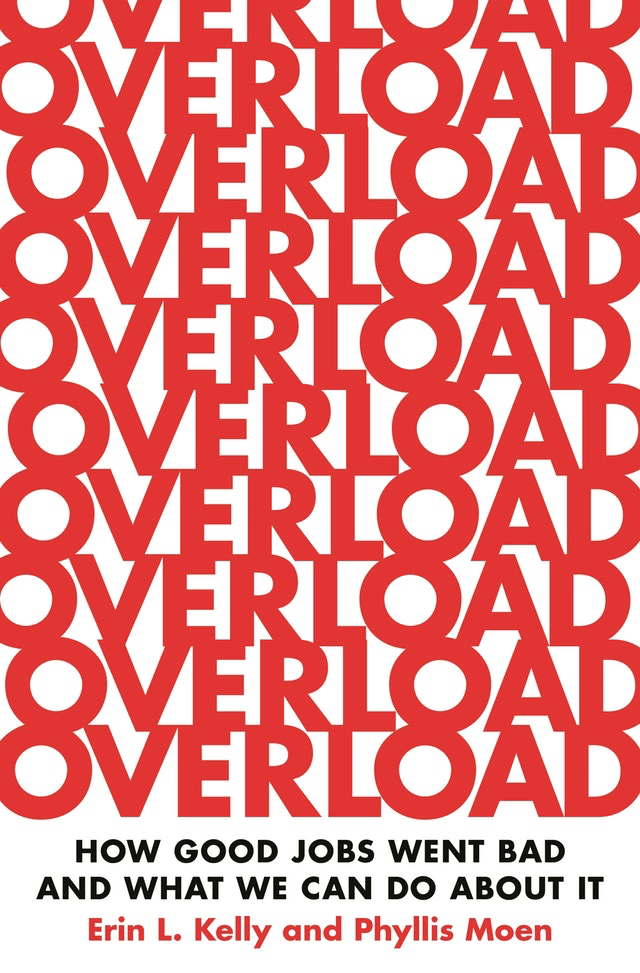
Member Publication: Overload: How Good Jobs Went Bad and What We Can Do About It

Please check out the forthcoming publication by OOW members Erin Kelly and Phyllis Moen. 2020. Overload: How Good Jobs Went Bad and What We Can Do About It. Princeton: Princeton University Press.

The book will be released on March 17, 2020. Here is a short description:

Today’s ways of working are not working—even for professionals in “good” jobs. Responding to global competition and pressure from financial markets, companies are asking employees to do more with less, even as new technologies normalize 24/7 job expectations. In Overload, Erin Kelly and Phyllis Moen document how this new intensification of work creates chronic stress, leading to burnout, attrition, and underperformance. “Flexible” work policies and corporate lip service about “work-life balance” don’t come close to fixing the problem. But this unhealthy and unsustainable situation can be changed—and Overload shows how.

Drawing on five years of research, including hundreds of interviews with employees and managers, Kelly and Moen tell the story of a major experiment that they helped design and implement at a Fortune 500 firm. The company adopted creative and practical work redesigns that gave workers more control over how and where they worked and encouraged managers to evaluate performance in new ways. The result? Employees’ health, well-being, and ability to manage their personal and work lives improved, while the company benefited from higher job satisfaction and lower turnover. And, as Kelly and Moen show, such changes can—and should—be made on a wide scale.

For further information and to purchase the book, visit Princeton University Press’ website or Amazon.

Organizations, Occupations, and Work Award Nominations Calls

OOW Distinguished Career Award

The Distinguished Career Award recognizes and celebrates a career of contributions to the area(s) of organizations, occupations, and/or work. Nominations are judged on the depth and breadth of scholarly impact over an extended time and across multiple projects.

Section members may nominate a distinguished scholar by sending (1) a letter (PDF or MSWord) of nomination, which outlines the candidate’s scholarly contributions to the field and provides assurance of the candidate’s willingness to be nominated, (2) a copy of the candidate’s most recent curriculum vitae, and (3) full contact information for the nominee (including email address), to the Chair of the selection committee. To receive full consideration, nominations must be submitted by March 31, 2020.

The members of the 2020 Distinguished Career Award Committee are the officers of the OOW section. Please submit nominations to:

Tim Bartley
Department of Sociology
Washington University
bartleyt@wustl.edu

Max Weber Book Award

The Max Weber Award for Distinguished Scholarship is granted for an outstanding contribution to scholarship on organizations, occupations, and/or work in a book published within the last three years (2017-2019). A book may be nominated by its author(s), by its publisher, or by any ASA member.

To nominate a book, send (1) a copy of the book and (2) contact information for the nominee (including an email address) to each member of the selection committee at the addresses below. Publishers who wish to submit a book for consideration must include a nomination letter that states how the book contributes to scholarship on organizations, occupations, and/or work. To receive full consideration, nominations must be submitted by March 31, 2020.

Please submit your nomination to each of the members of the 2020 Weber Book Award Committee:

Chair: LaTonya Trotter
Department of Sociology
Vanderbilt University
PMB 351811
Nashville, TN 37235-1811
l.trotter@vanderbilt.edu

Joseph C. Hermanowicz
Department of Sociology
University of Georgia
324A Baldwin Hall
Athens, GA 30602-1611
jch1@uga.edu

Michelle Maroto
Department of Sociology
University of Alberta
6-23 Tory Building
Edmonton, AB T6G 2H4
maroto@ualberta.ca

Richard E. Ocejo
Department of Sociology
John Jay College and the Graduate Center, CUNY
John Jay College, CUNY
524 W. 59th St.; 520.12HH
New York, NY, 10019
rocejo@jjay.cuny.edu

Hana Shepherd
Department of Sociology
Rutgers, The State University of New Jersey
26 Nichol Avenue
New Brunswick, New Jersey 08901
hshepherd@sociology.rutgers.edu

James D. Thompson Graduate Student Paper Award

The James D. Thompson Award is given for an outstanding graduate student paper on organizations, occupations, and work written within the last three years (2017-2019). The winner receives $500 for travel to a professional meeting. Authors may nominate themselves, or section members may do so. To nominate a paper, send (1) a PDF file of the paper or a functioning URL where it can be accessed, (2) a letter (PDF or MSWord) justifying the nomination, and (3) contact information for the nominee (including email), to each member of the selection committee. To receive full consideration, nominations must be submitted by March 31, 2020.

Please submit your nomination to each of the members of the 2020 Thompson Award Committee: 

Chair: Michael Sauder
Department of Sociology
University of Iowa
Michael-sauder@uiowa.edu

Erynn Casanova
Department of Sociology
University of Cincinnati
erynn.casanova@uc.edu

Michael Gibson-Light
Department of Sociology
University of Denver
Michael.Gibson-Light@du.edu

Adilia James
Department of Sociology
Endicott College
ajames@endicott.edu

Megan Neely
Department of Sociology
Stanford University
mtneely@stanford.edu

Richard Scott Article Award

The W. Richard Scott Award for Distinguished Scholarship is granted for an outstanding contribution to scholarship on organizations, occupations, and/or work in an article published within the last three years (2017-19). An article may be nominated by its author(s) or by any ASA member.

To nominate an article, send (1) a PDF file of the article or a functioning URL where it can be accessed, (2) a letter (PDF or MSWord) justifying the nomination, and (3) contact information for the nominee (including email), to each member of the selection committee. Publication date is based on print publication for traditional journals (i.e., not online-first date), and release date for online-only journals. To receive full consideration, nominations must be submitted by March 31, 2020.

Please submit your nomination to each of the members of the 2020 Thompson Award Committee members:

Chair: Sarah Thebaud
Department of Sociology
University of California-Santa Barbara
sthebaud@soc.ucsb.edu

Joe Broschak
Department of Sociology
University of Arizona
broschak@email.arizona.edu

Reggie Byron
Department of Sociology
Southwestern University
byronr@southwestern.edu

Amanda Sharkey
Department of Organizations and Strategy
University of Chicago
sharkey@chicagobooth.edu

Ben Shestakofsky
Department of Sociology
University of Pennsylvania
bshesta@upenn.edu

Olav Sorenson
School of Management
Yale University
olav.sorenson@yale.edu

Job Posting: Postdoctoral Research Fellowship in Arts & Public Policy at Vanderbilt

The Curb Center at Vanderbilt invites applications for a Postdoctoral Research Fellowship in Arts & Public Policy as part of the Curb Center at Vanderbilt’s Public Policy program, to begin on August 1, 2020.

The Curb Center at Vanderbilt is a national policy center committed to research and learning that challenge leaders to rethink the role of creative and cultural expression in contemporary society. The successful candidate will work closely with the Associate Director of Public Policy on various arts-related research projects, primarily focused on the educational and career pathways of creative workers. The role provides an opportunity for an early-career academic professional to develop national and international policy research on a broad range of cultural policy issues. The successful applicant will also support the Assistant Director of Creative Enterprise and Public Leadership in the activities of the Creative Campus and Curb Scholars programs. There is no teaching associated with this appointment. Approximately half (50%) of the candidate’s time will be dedicated to their own research and scholarship.

This is a non-faculty, non-tenure track, one-year term appointment, with the possibility of a yearly extension contingent on funding and satisfactory performance. The fellow will join a cohort of other postdoctoral fellows across Vanderbilt University and have access to the professional development support of the Office of Postdoctoral Affairs.

The position is full time and carries a competitive salary, commensurate with the applicant’s experience and qualifications, plus health insurance coverage as specified by Vanderbilt University guidelines. The Postdoctoral Research Fellow’s primary appointment will be in the Department of Sociology, with all funding for the position coming from Curb Center resources.

The successful applicant will have the following qualifications:

  1. A Ph.D. in Sociology or a field relevant to the broad aims of the program (i.e., social sciences, arts, humanities, law, information science, etc.) by start date.
  2. Research expertise relevant to cultural policy, broadly construed (including cultural production and consumption, work and careers, creative cities, etc.).

To apply for the Postdoctoral Research Fellowship, submit the following materials in digital format:

  1. A cover letter expressing interest in the position;
  2. A current curriculum vitae;
  3. A transcript of graduate work (unofficial is acceptable);
  4. Two writing samples;
  5. The names and contact information for three references.

Applications and inquiries should be sent to Kimberly Kane (kimberly.kane@vanderbilt.edu).

Review of applications will begin on February 1, 2020, but applications will be considered until the position is filled.

Vanderbilt University is an equal opportunity, affirmative action employer. Women, minorities, people with disabilities and protected veterans are encouraged to apply.

Member Publication: Divested: Inequality in the Age of Finance

Please check out the following recent publication by OOW members Ken-Hou Lin and Megan Tobias Neely: Divested: Inequality in the Age of Finance. 2020. New York: Oxford University Press.

Here is a short description of the book:

Finance is an inescapable part of American life. From how one pursues an education, buys a home, runs a business, or saves for retirement, finance orders the lives of ordinary Americans. And as finance continues to expand, inequality soars.

In Divested, Ken-Hou Lin and Megan Tobias Neely demonstrate why widening inequality cannot be understood without examining the rise of big finance. The growth of the financial sector has dramatically transformed the American economy by redistributing resources from workers and families into the hands of owners, executives, and financial professionals. The average American is now divested from a world driven by the maximization of financial profit.

Lin and Neely provide systematic evidence to document how the ascendance of finance on Wall Street, Main Street, and among households is a fundamental cause of economic inequality. They argue that finance has reshaped the economy in three important ways. First, the financial sector extracts resources from the economy at large without providing economic benefits to those outside the financial services industry. Second, firms in other economic sectors have become increasingly involved in lending and investing, which weakens the demand for labor and the bargaining power of workers. And third, the escalating consumption of financial products by households shifts risks and uncertainties once shouldered by unions, corporations, and governments onto families.

A clear, comprehensive, and convincing account of the forces driving economic inequality in America, Divested warns us that the most damaging consequence of the expanding financial system is not simply recurrent financial crises but a widening social divide between the have and have-nots.

Job Posting: Postdoctoral Researcher at Stanford Graduate School of Business

Principal Investigators Dr. Julien Clement and Dr. Jon Atwell of the Stanford Graduate School of Business seek to fill a position for a postdoctoral researcher. This researcher will collaborate with both Dr. Clement and Dr. Atwell on projects related to organizational structure and organizational adaptation. This is a two-year position assuming academic achievement and service at a level at or above expectations, with annual formal reviews.

The ideal candidate will have a PhD in a social science field, have a strong interest in organizational adaptation and design and have strong technical skills in empirical analysis and programming. They will have the opportunity to use a wide range of methodologies including formal modeling, large group experiments, and empirical analyses using both traditional statistical and machine learning techniques. Depending on the applicant’s interests, the position may involve substantial input on the development of projects and co-authored work with the PIs. The role will also allow for a proportion of time dedicated to publishing the applicant’s own ongoing research projects. It will also involve some work coordinating other research support.

The desired start date of the position is early summer and completion of the PhD degree is required before the appointment starts. If hired, the applicant will be a member of the Organizational Behavior group at Stanford GSB and will be able to participate in group seminars, workshops and informal knowledge sharing. The position comes with health benefits and access to most Stanford resources.

Candidates that have accepted tenure-track positions at another institution with the ability to defer their start date will also be considered.

Qualifications

PhD in a social science or other relevant field Strong programming skills
Strong communication skills

Applications need to include

  • A cover letter describing your interest in and qualifications for this position
  • Up to three writing samples that demonstrate your expertise and fit for the position
  • The names and contact information of up to three letter writers

Application Information

Please upload a single PDF with the above application materials to tinyurl.com/GSB- postdoc. Please title the file with your first and last name (e.g. Sarah-Smith.pdf) Applications will be considered upon submission but to ensure consideration applications must be submitted by February 15th.

Principal Investigators

Dr. Clement studies how the design of an organization affects the way people collaborate. How does an organization’s structure affect how its members form relationships and develop routines? How can it help them adapt these routines when environmental demands change? And when can organizations thrive without any formal structure? Dr. Clement has used a variety of analytical methods to answer these questions (network analysis, agent-based models, big-data analytics) in contexts including the television game-show industry, professional videogaming (e-Sports) and mobile healthcare in Africa. Most recently, he started studying how the deployment of artificial intelligence inside organizations may affect collaboration and learning among their members.

Dr. Atwell studies how groups of individuals communicate and consume social information. At the root of society is the creation of broadly-shared understandings of the relevant social context but many features of the modern social life present potential pitfalls for that creative process. Using simulations, large-group experiments, and natural language processing, Dr. Atwell analyzes how different dynamic social processes produce, distribute and aggregate the information necessary for large groups to create these essential shared understandings. 

OOW Membership Renewal

Hello Everyone,

I just wanted to pass along a message from Melissa Wooten and the OOW membership committee as we wind up 2019 and start looking ahead to 2020.  In addition to renewing your membership, please consider submitting a paper to one of of our ASA sessions. The deadline is January 29th.

Michael Sauder

***

OOW Membership Renewal

Before you set your “out of office” email for the winter break, remember to renew your ASA and OOW membership! This is also a great time of year to consider donating a gift membership. ASA members can gift an ASA membership for students or section memberships for anyone at https://asa.enoah.com

Don’t know what to get that teaching assistant who graded all your papers this semester? Or that colleague who provided  feedback on your manuscript? How about an OOW membership? 

To purchase a gift ASA membership for students:

Once logged into the member portal, please click “Purchase a gift membership for a student” under the Contribute/Give heading. Students 
can be searched by name through the online member database. A new contact record can be created by the member if the student is not found in the database.

Your gift will be redeemable by the recipient for a ASA student membership (or a $52 discount on another membership type). Your gift recipient will receive their gift credit via email immediately after your purchase. Gift memberships are not refundable if unredeemed by the end of the 2020 membership year, September 30, 2020. Gift memberships are not tax deductible. The deadline for a 2020 gift ASA membership for students is July 31, 2020.

To purchase a gift section membership:

Once logged into the member portal, please click “Purchase a gift section membership” under the Contribute/Give heading. Select the section and search for your recipient by name. Section membership requires 2020 ASA membership. Only 2020ASA members who do not already have a membership in that section are eligible to receive a gift. Your recipient will receive an e-mail immediately after your  payment notifying them of the section gift. (Your name will be included in this message). If the recipient declines the gift within 30 days of  receipt, you will receive a refund by mail. Gifts are not tax deductible. The deadline for a 2020 gift section membership additions is July 31, 2020.

Wishing you a restful break,
OOW Membership Committee